In this episode of Chasing History, get a behind-the-scenes look at the Eastern and Western Conference Finals.
SAN ANTONIO — The New York Knicks are in the NBA Finals for the first time since 1999. And the opponent, amazingly, is the same as it was 27 years ago.
Really, both the Knicks and the San Antonio Spurs are very different from the teams that met in the 1999 Finals. While some of the Spurs’ leadership is the same, seven of the 10 players in the San Antonio rotation weren’t even born when the franchise won its first championship.
Today’s NBA is also dramatically different from that of 1999. Here are some numbers comparing this Finals matchup with the one when “If You Had My Love” by Jennifer Lopez and “Austin Powers: The Spy Who Shagged Me” were the No. 1 song and movie, respectively, in the United States.
1. Efficiency has come a long way
101.5 — Through the first three rounds of the 1999 playoffs, the Spurs and Knicks had combined to score 101.5 points per 100 possessions.
The Orlando Magic had the least efficient offense in the 2026 playoffs, scoring 101.9 points per 100 possessions. So the worst offense in those playoffs was more efficient than the two teams that reached the finals 27 years ago. And over the five games of the Finals, the Spurs and Knicks combined to score just 93.7 per 100.
The difference in efficiency was almost entirely about shooting. The 16 playoff teams in 1999 had a higher free throw rate and higher offensive rebounding percentage than teams this year. Turnover rate was higher in ’99, but shooting is the most important part of offense and…
- In 1999, the Spurs and Knicks had combined for an effective field goal percentage of 47.3% through the first three rounds.
- This year, the Spurs and Knicks have combined for an effective field goal percentage of 56.4% through the first three rounds.
That’s a huge difference.
2. Playing faster
87.8 — In the 1999 Finals, the Spurs and Knicks averaged 87.8 possessions (per team) per 48 minutes.
That would have been the slowest-paced series in this year’s playoffs by a wide margin. The slowest of the 14 series thus far has been the first round series between the Lakers and Rockets, who averaged 92.4 possessions (per team) per 48 minutes.
In the regular season, teams averaged almost 10 more possessions per 48 this year (100.2) than they did in the 1998-99 seasons (90.5).
With the lower efficiency and slower pace, the Spurs scored fewer than 100 points in 13 of their 15 playoff wins in 1999, and had fewer than 80 in two of them. The final score of the clinching Game 5 of the Finals was 78-77.
3. Three is greater than two
49 — Through the first three rounds in the 1999 playoffs, the Spurs made 49 3-pointers (4.1 per game).
Through the first three rounds of these playoffs, Julian Champagnie has made 46 3-pointers (2.6 per game).
The Knicks had just 53 3-pointers through the first three rounds in ’99, when the 16 playoff teams combined to 18.4% of their shots from 3-point range. This year’s postseason 3-point rate (40.2%) is only the fourth highest in the 47 years of the 3-point line, but it’s still more than double that of 27 years ago.
4. Streaking into the Finals
10 — Entering the Finals, the 1999 Spurs had won 10 straight games.
This year, it’s the Knicks who are streaking, having won 11 straight games with their sweeps of the Sixers and Cavs in the last two rounds. Back in 1999, the Spurs were tied 1-1 with the Minnesota Timberwolves in the first round. They won the final two games of that series (the first round was best-of-five) and then swept the Lakers and Blazers to reach the Finals.
With their wins in Games 1 and 2 of the Finals, the Spurs’ streak reached 12 games, the second longest (single-year) streak in NBA playoff history. The Knicks can match that if they win Game 1 on Wednesday.
Even though they were 11-1 through the first three rounds, the Spurs had outscored their opponents by just 8.2 points per game. They have a bigger differential (plus-10.3 per game) with a 12-6 record this year, while the Knicks’ point differential (plus-19.4 per game) would be the highest in NBA playoff history.
5. No rest for the best
45.5 — Tim Duncan averaged 45.5 minutes per game in the 1999 Finals.
No, none of the five games went to overtime. The Spurs were the franchise that brought load management to the NBA, but that was long after they won their first championship. The Spurs (basically) played an eight-man rotation in the ’99 Finals and Duncan’s lowest minutes total in the series (Game 1) was 43:26.
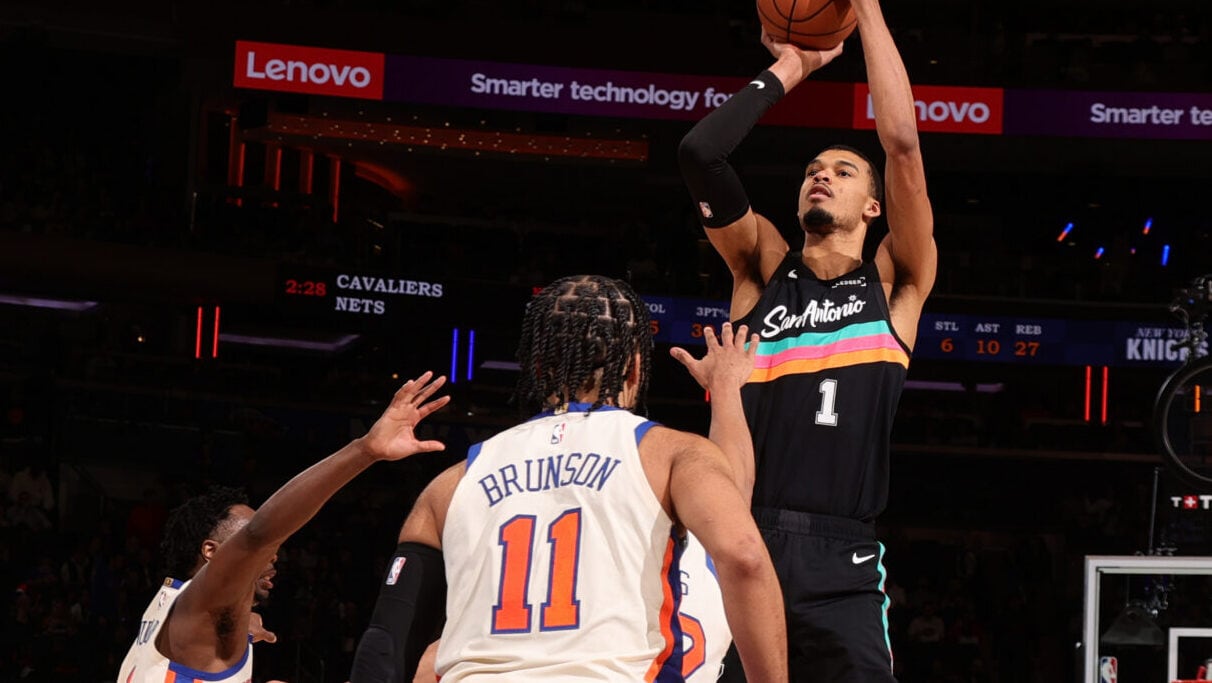
Victor Wembanyama has played that much just once in his 199 career games, and that was in the Spurs’ double-overtime victory in Game 1 of the Western Conference finals.
The Knicks also had an eight-man rotation in ’99, with Allen Houston (44.6) and Latrell Sprewell (44.1) both averaging more than 44 minutes in the Finals.
* * *
John Schuhmann has covered the NBA for more than 20 years. You can e-mail him here, find his archive here and follow him on Bluesky.