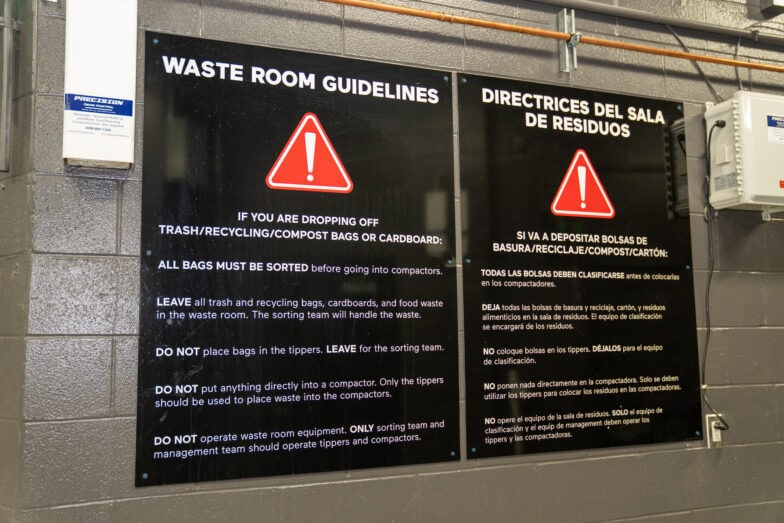
Cleveland Cavaliers’ new waste room, featuring upgraded systems to improve recycling and composting.
Behind the scenes, one thing keeps coming up across NBA teams and arenas: trash. Once the final buzzer sounds, staff get to work on collecting and sorting what gets left behind in the arena – from cans and popcorn buckets to program flyers and merchandise. Their goal: minimize the trash that gets sent to landfill or incinerators. Throughout the league, teams are implementing innovative waste management solutions that help increase recycling, food donations and composting while making a positive impact on the health and environment of their communities.
This work is no easy feat and largely affected by outside factors, including the type of waste management infrastructure that exists in its community and the operational capabilities of local waste haulers. Despite these challenges, NBA venues continue to develop and execute innovative solutions to reduce waste and achieve high levels of recycling, composting and food donations – with some striving for and achieving verifiable TRUE Zero Waste, an industry-leading certification that verifies a facility is keeping almost all of its waste out of landfills and incinerators.
Let’s take a closer look at how some NBA teams and arenas are tackling waste, highlighting several examples of strong work that is happening all across the league.
Atlanta Hawks: State Farm Arena
At State Farm Arena, its zero-waste program is represented by the “Full Court Press” sculpture, a piece of art in the shape of the Hawks logo that is made up of 404 pounds of upcycled aluminum cups and cans and serves as a visual reminder of the venue’s strong sustainability practices. As the world’s first TRUE Platinum Zero-Waste sports and entertainment venue, the Hawks and State Farm Arena are focused on creating meaningful partnerships to further their efforts.
Since 2021, the venue has diverted more than 13 million pounds of waste from landfills and incinerators. The organization views its zero-waste program – which encompasses recycling, composting and the donation of reusable materials – as a unified effort that prioritizes the future of their hometown. Geoffrey Stiles, Senior Vice President of Facilities and Events, says, “The most important thing to take away is the role that partners play in our work. It takes intentionality; you can’t do it alone… it would be impossible to reach these goals without our partners.”
Cleveland Cavaliers: Rocket Arena
The Cleveland Cavaliers are taking waste management “to the house.” They have invested in rebuilding their waste room and purchasing new equipment to enhance the arena’s sustainability efforts, recently tipping off a new era with a dedicated ribbon-cutting ceremony for the room. In partnership with Waste Management, the arena is actively working to reduce waste through recycling, composting, and reuse efforts.
This season, the arena achieved a 20% diversion rate and composted 181,240 pounds of food waste between July 1, 2024, and June 30, 2025 – a 50% increase from the previous season. This accomplishment comes soon after a newly-established municipal recycling program in Cleveland and one that they are excited to continue building on.
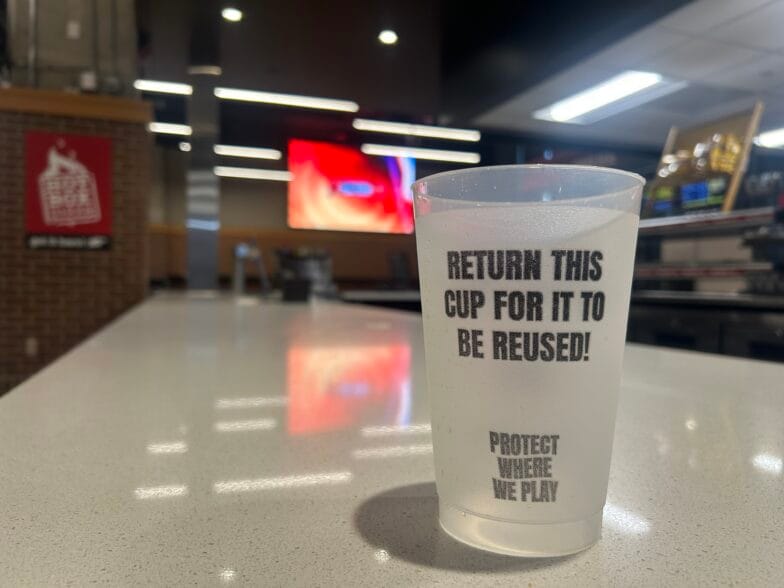
Reusable cups at Gainbridge Fieldhouse help cut single-use waste
Indiana Pacers: Gainbridge Fieldhouse
Gainbridge Fieldhouse recently completed a three-year renovation project titled “Fieldhouse of the Future”. A critical part of that project focused on advancing the arena’s environmental efforts in partnership with Recycle Force. The renovations have already reaped benefits, with the venue seeing a 37% increase in water efficiency and a 12% increase in energy efficiency.
Over the last 12 months, the Pacers have also increased overall waste diversion by 10%, demonstrating the success of expanded composting and recycling systems with Levy and Waste Management. This work has included piloting more advanced sorting methods to separate reusable, recyclable, and compostable items, with the remaining waste sent to a local waste-to-energy facility. These efforts were amplified during its first Sustainability Night earlier this season, achieving a 74% waste diversion rate – a 50% increase over its average. Other initiatives this past year included implementing reusable cups for the 2025 WNBA All-Star Game – a first for WNBA All-Star. Maddie Plank, Sustainability Project Coordinator notes, “We rolled out reusable cups throughout the venue during that weekend, and saw an 80% return rate. That’s a ‘wow’..what most venues strive for after a year or two, and we were able to execute it in one weekend.”
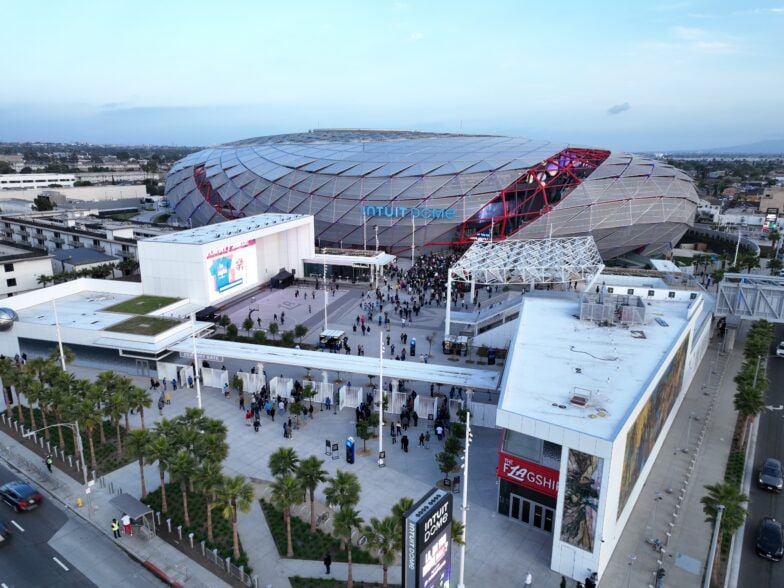
Los Angeles Clippers: Intuit Dome
Since opening its doors in 2024, Intuit Dome has been focused on sustainable operations, including achieving and maintaining Zero Waste – setting a goal to divert at least 90% of its material away from landfill, incineration, and the environment. The team takes a holistic approach to materials management. This includes looking upstream to minimize waste before it enters the building, ensuring sourced materials comply with recycling and organics requirements, conducting regular training with staff and vendors on best practices, and partnering with major events such as NBA All-Star to align sustainability goals and identify materials for donation and reuse post‑event.
For NBA All-Star 2026, this collaboration resulted in the recovery and donation of over 6,000 pounds of materials to community partners. This effort was supported by Intuit Dome’s Zero Waste Room, where all material discarded onsite is processed by a dedicated sorting team and directed into one of more than 20 streams, prioritizing reuse, donation, and recycling wherever possible.
Los Angeles Lakers: Crypto.com Arena
Have you ever been to Crypto.com Arena and seen the yellow bins throughout the concourse? Those bins play a key role in the arena’s effort to keep waste out of landfill and incinerators. The bins have played a role in the Los Angeles arena becoming one of the first major sports and entertainment venues in the U.S. to transition to reusable drinkware, avoiding the use of hundreds of thousands of single-use cups. The arena’s reusable drinkware program is the latest in its efforts to reduce landfill waste which includes collecting and recycling all plastic bottles, aluminum cans, and Tetra-Pack beverage containers from waste streams and recovering food waste to turn into usable soil.
Miami Heat: Kaseya Center
The Miami HEAT have worked to embed environmental stewardship across operations at the Kaseya Center and throughout the organization. Guided by a multi‑year sustainability action plan, the HEAT have expanded waste diversion through recycling, composting, and large‑scale food and material donation programs, while reducing single‑use plastics through partnerships and fan‑facing initiatives.
Most recently the Kaseya Center achieved over a 50% diversion rate. The organization continues to measure energy and water efficiencies within the arena and invest in community resiliency planning through initiatives like food recovery, environmental education, and more. As of the 2025-2026 season the HEAT donated over 93,000 lbs. of unused food to local shelters. Together, these efforts aim to reduce environmental impact while positively engaging fans, partners and the South Florida community.
Milwaukee Bucks: Fiserv Forum
If food waste were a country, it would be the third-largest emitter of greenhouse gases in the world. This remains top of mind for the Milwaukee Bucks, who are “swatting away” greenhouse gas emissions through a comprehensive sustainability strategy – which includes combating both food and material waste.
Part of the swatting is done through an ORCA food digester for organic waste, a rigorous post-event material sorting process, and recycling of all plastics, glass, and aluminum. The ORCA breaks down food into “gray water”, which is safe for the city’s water system, and sends organic waste to facilities that convert it into energy, fuel, or fertilizer. In addition, the Bucks actively donate excess food from the arena to communities in need across Milwaukee. Collectively, these initiatives aim to reduce waste sent to a landfill or incinerator through efficient recycling, composting, and material recovery.
Portland Trail Blazers: Moda Center
In Portland, the Rip City Reuse program has played a central role in their effort to reduce arena waste. As Brittany Saulsbury, Director of Sustainability, explains, “All cups in the arena are reusable. It creates a meaningful impact because it eliminates waste before it exists, which is fundamentally more effective than managing it downstream. The program has eliminated over 1.5 million single‑use cups while creating a highly visible, fan‑facing sustainability experience.”
The Trail Blazers are also tackling food waste, turning organic scraps into soil in partnership with Annen Brothers Farm, which contribute to over half a million pounds of material diverted from landfills annually. Furthermore, the team partners with local nonprofits including Blanchet House and Urban Alchemy to ensure excess food from the Moda Center goes to local communities facing food insecurity.
If you’re interested in learning more about the NBA’s environmental sustainability work, visit nbagreen.com.