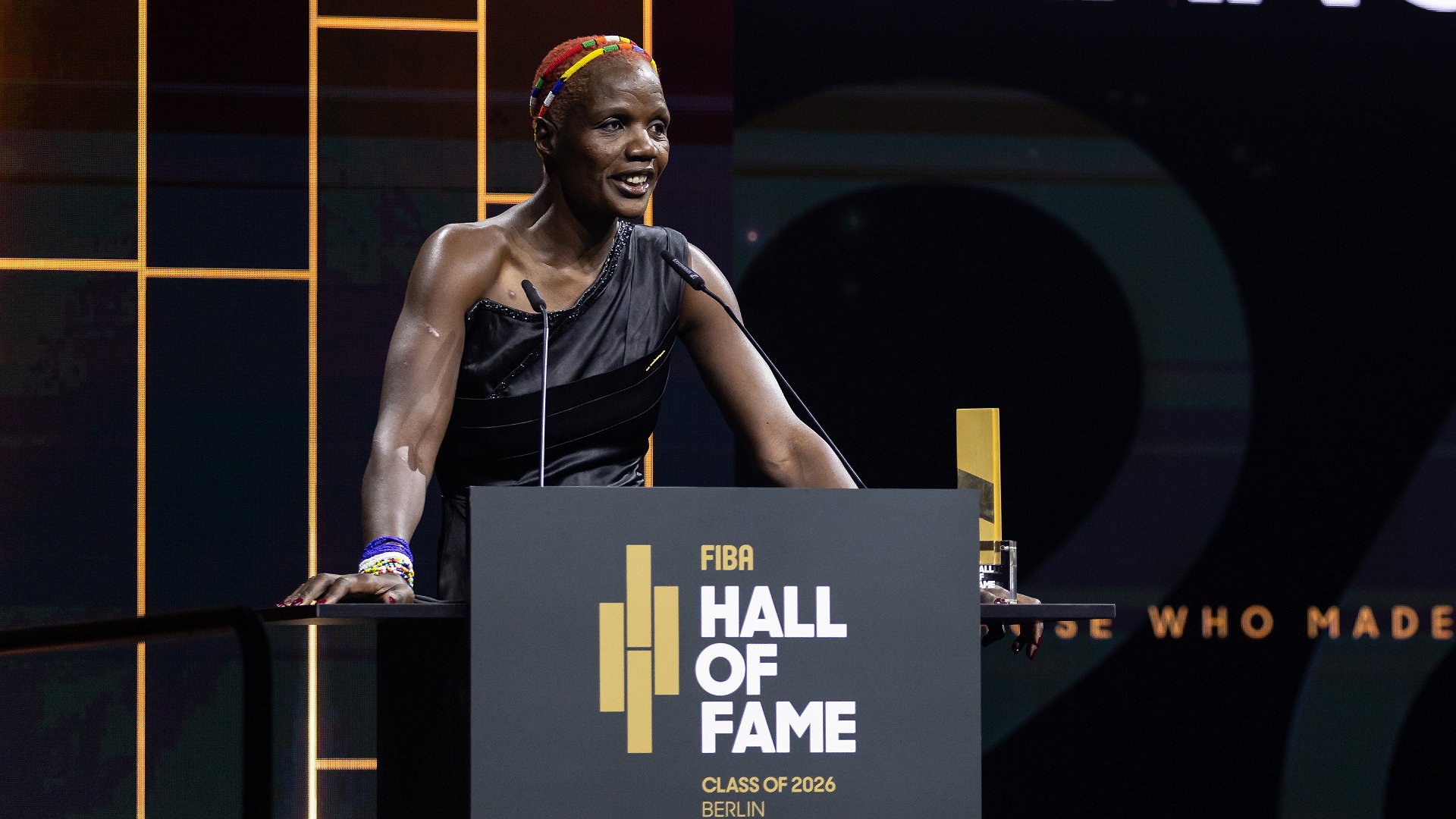
Former WNBA player Clarisse Machanguana entered the FIBA Hall of Fame in 2026. (Photos courtesy of Clarisse Machanguana)
The juxtaposition divided Clarisse Machanguana’s heart.
Alongside basketball luminaries including Sue Bird and Dirk Nowitzki, Machanguana was inducted into the FIBA Hall of Fame on April 21.
In her enshrinement speech, she recalled the opportunities she was afforded and took advantage of as a young girl in Mozambique. Those opportunities led to a college basketball career at Old Dominion University and a pro career in the WNBA and internationally. She talked about the Clarisse Machanguana Foundation and how she is trying to provide similar opportunities for kids, especially girls, in Mozambique.
An inspiration to new generations, an inspiration to all of us. 🥹
Thank you, Clarisse Machanguana. 🇲🇿 pic.twitter.com/JwvWdKXQrq
— FIBA Basketball (@FIBA) April 21, 2026
She told NBA.com that her induction into the FIBA Hall of Fame “brings reassurance to Mozambique youth that it is possible despite the challenges that we go through, and if we were to get the tools to go further, we would excel.”
Her joyous heart was in Berlin for the celebration of her life’s work as a basketball player and philanthropist. Five thousand miles away on another continent, her anguished heart was in her native Mozambique, where generational flooding has killed nearly 300 people and displaced nearly 500,000 others, including Machanguana.
Machanguana lives in Marracuene, which is 20 miles north of Maputo, the capital of Mozambique. The town is alongside the Incomati River, which flooded the region. Her home is not structurally safe to live in, and she is staying with her brother until she finds a new place.
“I’ve been here 45 days, and I still don’t have a solution as to when I will have a home,” said Machanguana, who has a GoFundMe page to help her transition to a new home.
Heavy rainfall in the country began in December and extended into January. Combined with overflowing reservoirs, land along the Limpopo and Incomati rivers flooded, destroying or damaging more than 30,000 homes, according to Mozambique’s National Institute of Disaster Management. Officials worried about the structural integrity of dams and released more water into already overwhelmed rivers.
“Most people went back to very unlivable conditions,” Machanguana said. “I’m fortunate to have an option. Most people don’t.”
According to the United Nations Office for the Coordination of Humanitarian Affairs, flooding has impacted 447,000 acres of farmland and resulted in the loss of nearly 58,000 livestock and “overcrowding in accommodation centers, combined with damage to water and sanitation infrastructure, has increased public health risks, including the potential for waterborne disease outbreaks.”
Machanguana pointed out that farmers lost a season’s worth of crops, resulting in a twofold problem.
“Everything that they were supposed to eat or sell is gone,” she said. “It will take another year also for them to have food for themselves and then food to sell and then be able to eat.”
‘I needed to endure’
Machanguana was born in Mozambique, and her potential as a basketball player because of her height was recognized. It was a difficult transition from Mozambique to college in the United States. Practices were demanding, and school required extra work because her English, by her admission, was limited.
“I knew that if I went back home, I would just be another girl who would have a life less than I could,” said Machanguana, who is 6-foot-5. “I understood that I needed to endure, and it was the best thing that I did. I realized I had the option to not pursue it, but the result I will get from just quitting is worse.”
She starred at Old Dominion, earning Colonial Athletic Association Player of the Year in 1995, and in her senior season, she averaged 19.9 points and 7.4 rebounds while shooting 63.6% overall. She was named to the 1996-97 All-America second team (her teammate, Ticha Penicheiro, was first team), as ODU lost to Tennessee in that season’s national championship game.
She was drafted by the Los Angeles Sparks in the second round of the 1999 WNBA Draft and played four seasons in the WNBA. She played professionally overseas and retired in 2013 and returned to Mozambique.
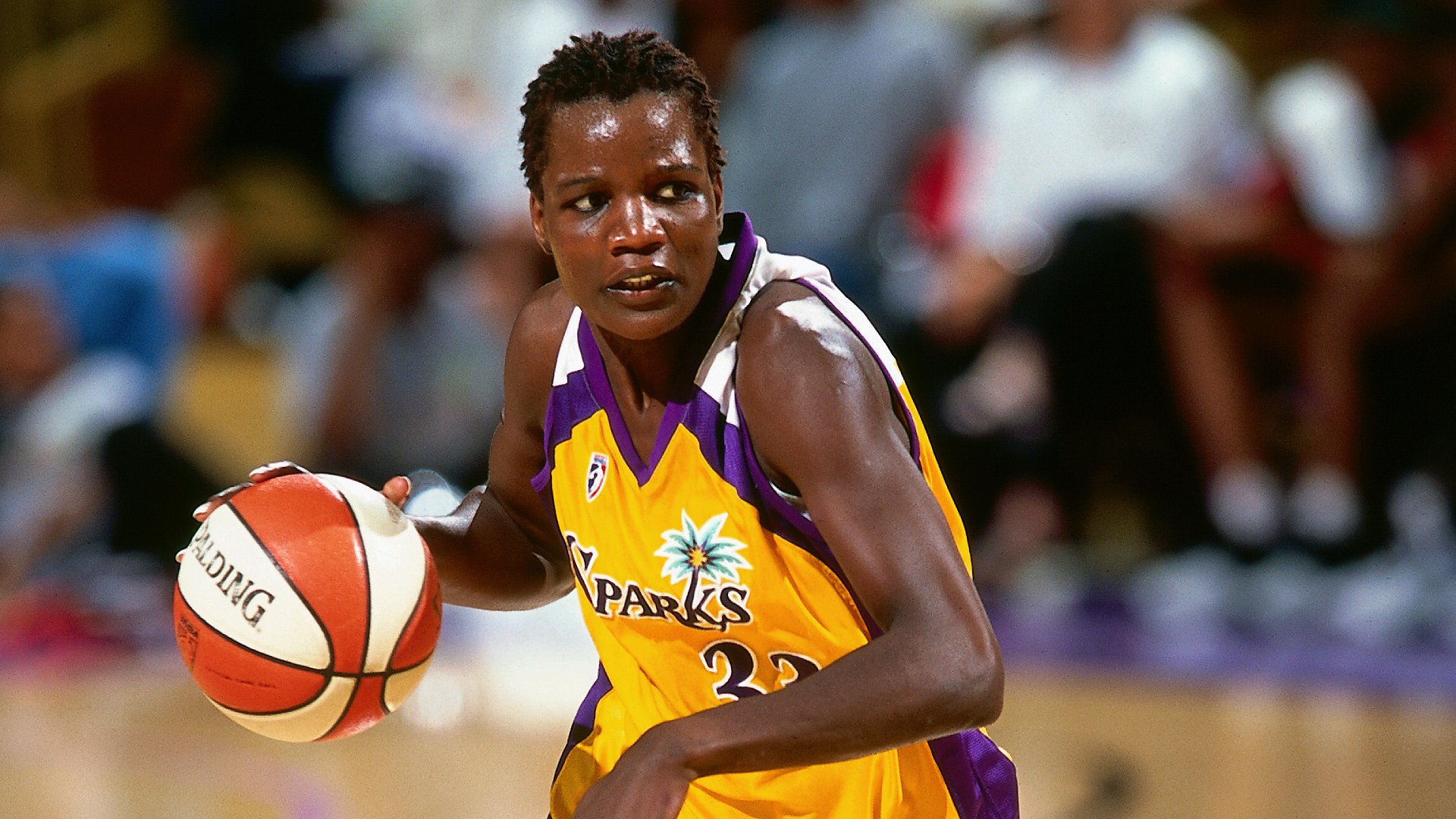
Clarisse Machanguana played for three teams — the LA Sparks, Charlotte Sting and Orlando Miracle — in her four WNBA seasons.
She considered what she wanted to do after playing and decided coaching wasn’t for her. She started the Clarisse Machanguana Foundation.
“I felt like I had won a lottery amongst millions in Mozambique and I needed to share a way for other youth to have those opportunities,” she said.
The focus of the foundation is on girls around 11 years old, where she can “ensure we work on self-esteem and bring awareness to girls of the important values of protecting their body and having an outlook on the world that it doesn’t stop with early marriage.”
The foundation has embraced digital literacy and STEM programs. She also works with the Jr. NBA/Jr. WNBA programs. Between that and her foundation, more than 25,000 kids have participated.
Noemia Massingue participated in the first Jr. NBA/WNBA program in Mozambique when she was 12 years old. She moved to the United States and played basketball at the College of Staten Island and graduated with a degree in business administration last year.
“We are now eager to build an academy where sports and education can be parallel learning that they get in order to continuously instill important values and life skills that allow them to pursue college,” Machanguana said.
Machanguana spends her time with the Jr. NBA/Jr. WNBA program, which has 360 participants still searching for a place to live.
“I’m always looking for land, but the way my day starts is that I go for a run at 4 a.m. and then I have breakfast and then I go to work,” she said. “This is the difficult part because most of the times I ask people to support my foundation, and now I find myself in a delicate place where I have to ask for help for me, but it would be nice that people, if people could understand that I have an amazing opportunity and privilege to pass on the amazing learning that I got in US and in Europe, and I need all the strength that I can to provide.
“Having a home after dedicating my daily hours to youth, having a home would give me the energy to restart in the morning. And right now I’m a bit imbalanced with that.”
* * *
Jeff Zillgitt has covered the NBA since 2008. You can email him at jzillgitt@nba.com, find his archive here and follow him on X.