Editor’s Note: Read more NBA coverage from The Athletic here. The views on this page do not necessarily reflect the views of the NBA or its teams.
***
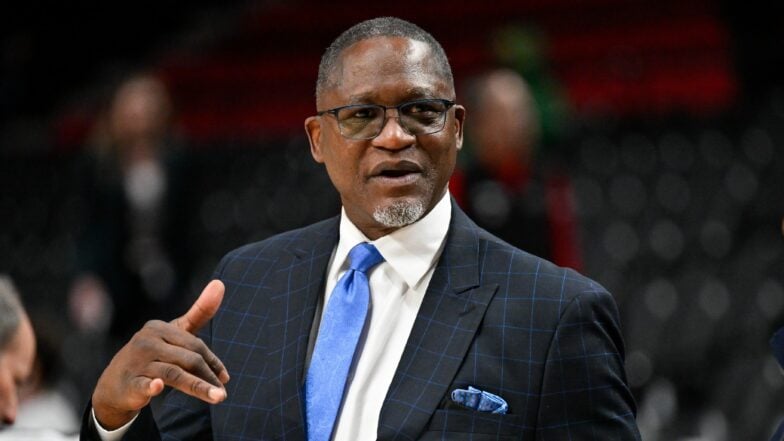
Dominique Wilkins takes his customary seat: front row behind the official scorer at center court. He’s eager for tipoff at the University of Georgia’s season opener against Bellarmine on this early November evening. When he’s at Stegman Coliseum in Athens, Ga., Wilkins tries to blend in. To not make a scene. To pretend as if everyone doesn’t recognize him.
This arena used to be his. From 1979 to ’82, the high-flying forward known as the “Human Highlight Film” starred for the Bulldogs, dunking over anyone in his midst before embarking on a 15-year Hall of Fame NBA career that saw him win two slam dunk contests, a scoring title and a spot on the league’s 75th Anniversary Team.
None of that is on his mind this night. His eyes track a young man on the court with a striking resemblance: a tall, lanky frame. Bright eyes. A budding goatee. Jacob Wilkins, Dominique’s 19-year-old son, is a 6-foot-9 freshman forward for the Bulldogs known for similar off-the-charts athleticism and dunking prowess.
Dominique knows how many other father-son basketball duos there are right now. Stephen Curry followed Dell Curry, as did other notable pairs: Klay and Mychal Thompson; Jalen and Rick Brunson; Tim Hardaway Jr. and Sr.; Gary Payton II and his father. LeBron and Bronny James became the first (and still only) father-son duo to suit up in an NBA game together. A handful of former NBA stars’ offspring are also budding standouts in the NCAA, including Carmelo Anthony’s son Kiyan (Syracuse), Carlos Boozer’s twin sons Cameron and Cayden (Duke) and Gilbert Arenas’ son Alijah (USC).
But the Wilkins’ story is different. Jake, as he goes by, didn’t have the traditional prodigy upbringing filled with praise and scholarship offers by middle school. He learned to love the game much later. He and his father haven’t been as widely publicized as some of their counterparts. Perhaps it’s because Dominique, 65, is of an older generation — one in which Gen Z YouTube watchers are less familiar. Or maybe because Jake isn’t as highly touted across 2026 NBA Draft boards. It’s still unclear whether he will declare after the season or stay another year in college. (“That’ll come when it comes,” Dominique says on the draft question. “My whole thing for him is developing to be the best player he can be, if that’s one year, two years … it’s about him developing.”)
But this night, during Jake’s debut, he and his father aren’t thinking about the future — or the past. Only right now. The next play. As players shoot around, Jake cradles a ball before blowing past an imaginary defender to hammer home a dunk. Dominique smiles.
But inside, he’s on edge. (“I was nervous as hell,” he’ll recall later.) Not because of expectations for Jake or the Bulldogs. Or even the potential NBA future that lies ahead. Or even the doubters that question his son’s ability — and wonder if he’ll ever live up to his family’s name. Nerves just always trickled up and down his body before his own games playing with the Atlanta Hawks, as well as a handful of other teams he played for: the Boston Celtics, Orlando Magic, San Antonio Spurs and LA Clippers.
“I was confident as anybody who played this game going into battle,” Dominique says, “but it’s the nervousness that kept me sharp and prepared to go to war.”
His son looks just as focused, especially after the two exchange words. Before each game, Dominique shares familiar mantras with him:
Always bring it. Be the one to hit first.
Go out and make a statement every time you play.
Don’t leave anything at home.
Jake turns to the stands for one last glance at his father before tipoff. “When I see him in the stands,” Jake says, “I got all types of confidence.” And on this night, he felt calmer than his nine-time All-Star father. “I actually wasn’t nervous. I thought I would be,” Jake says, “but I wasn’t.”
There are moments this season when Jake will throw down a mind-bending slam, looking like the spitting image of his father. Against Morehead State in November, for example, he rose up for a windmill dunk — Dominique’s signature — but off an alley-oop, creating an even higher level of difficulty. It made SportsCenter’s Top 10.
Dominique could hardly contain himself in his seat. “Do you see what the hell he just did?!” he blurted out to a family member.
The play was over, and the Bulldogs were back on defense, but Dominique still re-played the sequence in his mind, brimming with pride. The way his son rose to the basket. The composure to finish the play. The scream on the way down.
It’s me, Dominique thought.
“Nique, you knew he’d get up,” the family member responded, snapping him back into the present. “Why are you so impressed?”
How can he put it into words? A son that he had hoped for all his adult life came into being when he was 46 years old, after having five daughters and inheriting four other daughters from his current wife, as well as being a father to his stepson, Isaiah Wilkins, a former ACC Defensive Player of the Year at Virginia. He says he loves all his children equally, but Jake was special in his own way.
And now he’s here. On that court. Running. Jumping. Thriving. Jake is no longer the 5-year-old giggling in the driveway as Dominique rebounded the ball for him, wondering if he’ll take to the sport one day.
Jake is now his own man, trying to figure out how to honor his father’s legacy while creating his own.
When Jake was a baby, Dominique used to marvel to family members: “Look at his feet! Look at his arms and hands! It don’t even match his body. His feet’s too big for such a little kid.” He’d tell them: “Watch. He’s gonna be an athlete.”
“They’d give me that sarcastic pat on the back. ‘Yeah, I know. It’s your son! That’s what you’re supposed to say,’” Dominique recalls.
Dominique was just thankful to have him. From the moment Jake opened his eyes, Dominique felt a deep connection.
“I didn’t realize that I was wanting to be a parent at that age. Not a new parent, but having a young kid at that age,” he says. “But I always wanted a son. So, I was delighted — delighted — when I found out he was a boy.”
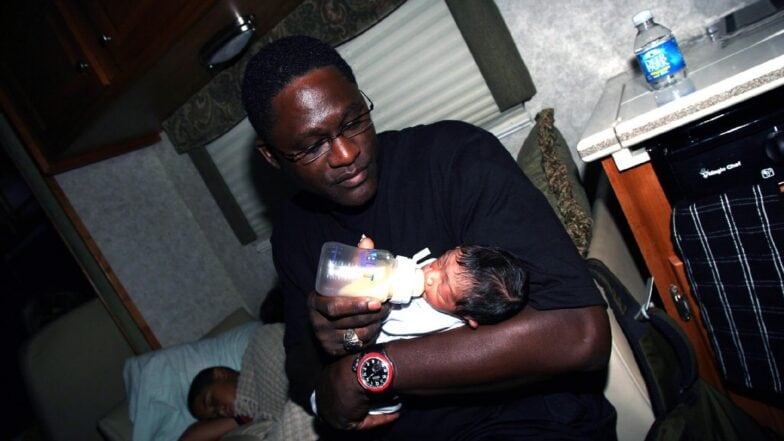
Dominique Wilkins feeds Jake during a bus trip from Atlanta to Springfield, Mass., for enshrinement in the Basketball Hall of Fame in 2006.
Dominique hoped Jake would play basketball but didn’t want to force anything or push him the way he saw a lot of other parents doing. If his son wanted to be a doctor, Dominique said to himself, he’d be just as thrilled.
Jake didn’t take to basketball immediately like Isaiah, who saw time in the G League and played overseas but now coaches at Cal. Basketball was something young Jake did, competing against Isaiah, 11 years his senior, as well as his cousins and uncles. Dominique’s brother, Gerald Wilkins, played 13 years in the NBA, while Dominique’s nephew, Damien Wilkins, played for 10.
Dominique and young Jake would shoot in the driveway not because the father wanted his son to become Somebody. It was simply their time. A time to laugh. A time to talk. Soon, Jake was beginning to warm up to the sport — so much so that by age 11, he told his father one afternoon, “I know I can make it.”
Dominique looked at his son in a way only fathers can; through him, not just at him. There was so much he wanted to say. His son wouldn’t have anything handed to him — no matter his last name. He’d have to work for everything he’d get. He’d face impossible expectations.
“I don’t want you to be me,” he told Jake that day. “I want you to be better than me.”
Something shifted in Jake. A newfound confidence and determination to become serious about basketball. It filled him with a sense of purpose he hadn’t felt before. He would try to forge his own path — even if it looked much different than his peers.
Unlike most sons of famous fathers, he wasn’t an immediate star. He wasn’t racking up scholarship offers at age 13. (As soon as Bronny was born, for example, Kentucky’s John Calipari sent LeBron scholarship papers.)
“There was a point where I wasn’t as good as everybody,” Jake says. “I was OK, but there were people who were clearly better.”
That motivated him and made him work harder. “He had a decision to make about how seriously he was going to take it,” says Isaiah, 30. “He really started to work, and I think that’s the best way. I don’t think he’s got to face any burnout or anything like that, just because he kind of took his time and decided what was right for him.”
Dominique stressed fundamentals, one day taking away the crank in their driveway hoop that allowed the boys to lower the rims to practice outlandish dunks. He wanted to make a point: They were going to work on shooting form and other fundamentals instead.
“I didn’t score 20,000 points or whatever off just dunking,” Isaiah remembers Dominique telling them. (Dominique scored 26,668 points, once placing eighth on the all-time list.) “You gotta learn how to play the game. You gotta know how to pass, to dribble.”
Jake made leaps in high school, twice becoming an All-State player and a four-star recruiting prospect. He ranked as high as No. 35 nationally in the 2025 class by Rivals.com. But as his son’s college dreams were coming into focus, Dominique thought about his own path and upbringing.
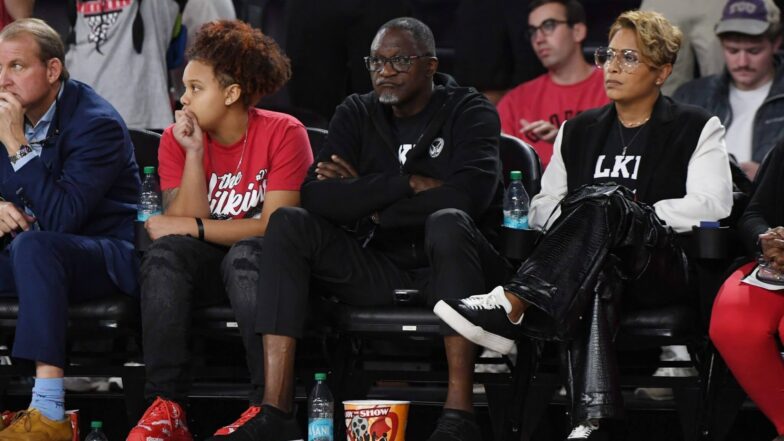
Dominique Wilkins watches Jake’s game on Nov. 17. He used to get nervous before his own games, which he said kept him sharp. Now he gets nervous watching his son.
The two were raised in dramatically different circumstances. Dominique grew up in a tough neighborhood in Baltimore in the 1960s and ’70s before being selected as the No. 3 pick in the 1982 NBA Draft. Dominique says the city inspired his competitive mentality. “At that time, it had the highest crime rate in America. And those streets taught me a lot,” Dominique says.
He remembers how one streetball legend, Big Harold, took him under his wing, and taught him everything he knew about basketball. About life. It helped Dominique become more independent, and at 16, he told his mother: “I’m leaving and I’ll never come back.” He went to North Carolina, where he had other family, to try to pursue his basketball dream.
“I didn’t have a father figure, you know, full-time, to help me navigate through this world,” Dominique says, adding that while his father is a “great man,” Dominique had to be a “a man of the house at 12” back then.
“I had to find a way on my own, and I just wanted to make sure my son didn’t have to go through that.”
“As a father, it’s my responsibility to show ways that weren’t shown to me,” he adds. “We’re supposed to make our kids better.”
I want you to be better than me.
Jake shares some similar attributes with his father. “I knew he was gonna be athletic,” says Dominique, who is now a TV color analyst for Hawks games, as well as a vice president for the team. “I didn’t know he was going to be that athletic.” They also share a competitiveness that Dominique feels has been passed on. It isn’t just the motor and passion they bring during the game, in that they never quit on a possession.
“Having no fear,” Dominique says. Jake told him he rarely loses a sprint in practice. Dominique was floored — eerily so. “When I was in high school, college and the pros,” Dominique says, “I never lost a sprint.”
Georgia coach Mike White says Jake has a great deal of upside: “His ceiling is very high. … Mentally, his biggest positive characteristic is his elite level of attention to detail.
“His level of focus is off the charts for a true freshman.”
What Jake also adds, his Georgia coaches say, is discipline, pushing himself each day to get better, constantly working on his jump shot, ballhandling, defense. Sometimes White has to tell him to slow down during walk-throughs at shootaround. “We do drills in practice that aren’t even live, and I mean, he’s going hard,” says junior guard Blue Cain. In the weight room, he tries to win any competition, whether it’s repetitions or finishing first in timed assault bike training.
He doesn’t take this Division I opportunity for granted, being a full-time starter on a ranked team, approaching each day with the same gratitude as the first time he approached his locker. He couldn’t believe it was his. “I used to dream about playing in college, just being here when I was a kid,” Jake says.
He also didn’t assume he could wear the same number, No. 21, as his father.
“Dad,” he asked him one day, nervously. “When I go there, could I wear your number?”
Dominique, who has the program’s lone retired jersey, “unretired” his number for Jake.
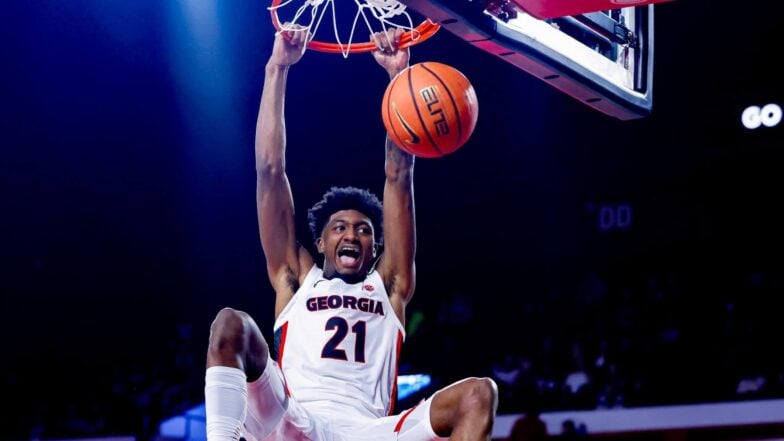
“There was a point where I wasn’t as good as everybody,” Jake says. He had to work hard on his game to reach this level. Sofia Yaker / UGA Athletics
That’s a lot of pressure — for anyone. Each time Jake plays, fans and media want to know: Is he actually good? Or is he just on scholarship because of his father? Does he have a legitimate shot at the NBA? Jake hears the chatter — what he calls “outside noise” — but he ignores it.
“It really goes in one ear and out the other way,” he says. “I never really let that get too much of my time, because most people don’t even know what they’re talking about. … I really don’t get into any of that.”
He acknowledges, though, that since jumping to the collegiate level, the noise has increased. But he doesn’t let himself stray from who he knows himself to be. Who his dad has been.
“He never forced me to play basketball,” Jake says. “It was kind of all on my own, so it was never a problem with me trying to create my own (legacy).”
Comparing him to his father is unfair and unrealistic for anyone. And Dominique doesn’t want to bring any more attention or pressure to his son, either. He wants him to focus on getting better and helping the No. 18 Bulldogs (13-1).
“I know what he can do,” Dominique says. “I’m never going to overhype him where I put him at risk. I’ll let his ability dictate itself, because that’s how much I believe in him.”
He always did.
Each Georgia practice, Jake tries to figure out how to bridge the gap between where he is and where he wants to be.
“Just pushing myself to be uncomfortable,” Jake says. That usually happens on the defensive end, when he challenges himself to guard off the ball or defend teammates who are quicker than him. He knows it’s a constant process of getting better.
“You can’t just get there overnight,” Jake says. “You have to take time out and sacrifice time out your day to really just work on you and perfect your craft so you can perform at the next level.”
His teammates don’t let up on him, either. One game, Jordan Ross, his roommate, noticed that Jake was too late to rotate over on a double-team from the baseline side on a drive. It was a close game and each possession mattered.
“I lit his ass up for that,” says Ross, a junior guard. “I yelled a couple of choice words. And he just said, ‘That’s me. It won’t happen again.’
“He can really take constructive criticism without getting defensive, which is really good for a young player.”
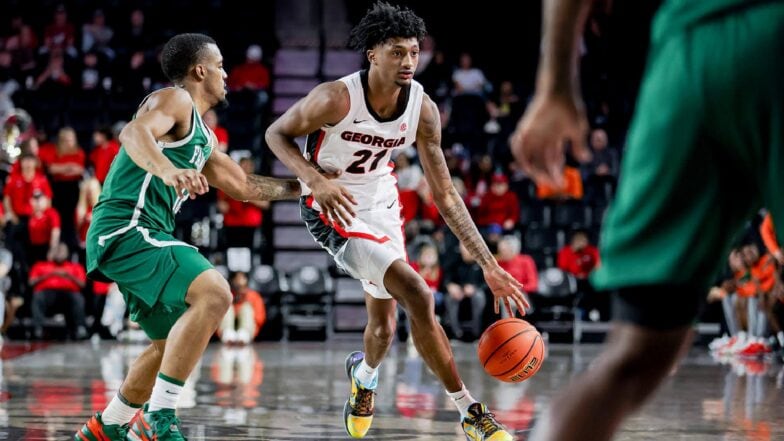
Dominique wanted to make sure his son had strong fundamentals: “I didn’t score 20,000 points or whatever off just dunking,” he told him.Conor Dillon / UGA Athletics
Jake’s goal is to make the NBA, but he is focusing on short-term objectives such as getting stronger in the weight room, which is something scouts have noticed as an area of improvement. “He has a really thin frame,” one NBA scout told The Athletic. “He needs to be able to play through contact a little bit more effectively. And it may take a long time for his body to come around and really handle the strength that is needed to play at the NBA level.”
“The strength for him is his size,” the scout also said. He did, however, praise Jake’s offensive development.
“One of the things that I love about him is the evolution of his jump shot,” the scout said. “You can tell he’s put in refinement from the last couple of years. … I think he’s started to make some real leaps, and a lot of the guys who have those natural tools and are the ones who make it at the NBA level are the ones who are pretty self-aware and recognize early.”
A former NBA scout told The Athletic: “If he becomes a consistent range shooter and defender, he’s going to give himself a great shot to step onto an NBA floor.”
Perhaps his biggest attribute is his coachability. He’s often asking his coaches if he did something correctly. “He’s constantly learning and putting pressure on himself to grow as a player,” White says.
That’s what Dominique sees between games. Far more than the highlights, the box scores. And that’s what makes him most proud. “Watching him grow,” Dominique says. There is no expiration date for that, no matter how much younger NBA superstars seem to get. No matter how much it feels like time is slipping away from them to meet superficial expectations.
There is a future for them outside of all of that — a future still unknown. One that is more spiritually rewarding than praise or criticism in scouting reports.
It can be found in the look Jake gives him, one last time in the stands before tipoff. It is in the look Dominique gives Jake each time he sees his son rise up for a dunk, softly landing — even letting himself get a little more animated, a little more confident, after returning to solid ground.
His son is in the beginning, messy, beautiful process of becoming.
It’s me.
It’s him. And whoever he might become.
***
Mirin Fader is a senior writer for The Athletic, writing long-form features, primarily on the NBA. Mirin is also the New York Times best-selling author of GIANNIS: The Improbable Rise of an NBA Champion and DREAM: The Life and Legacy of Hakeem Olajuwon. She has told compelling human-interest features on some of our most complex, most dominant heroes from the NBA, NFL, WNBA and NCAA, most recently at The Ringer. Her work has been featured in the Best American Sports Writing books. She lives in Los Angeles. Follow Mirin on Twitter @MirinFader