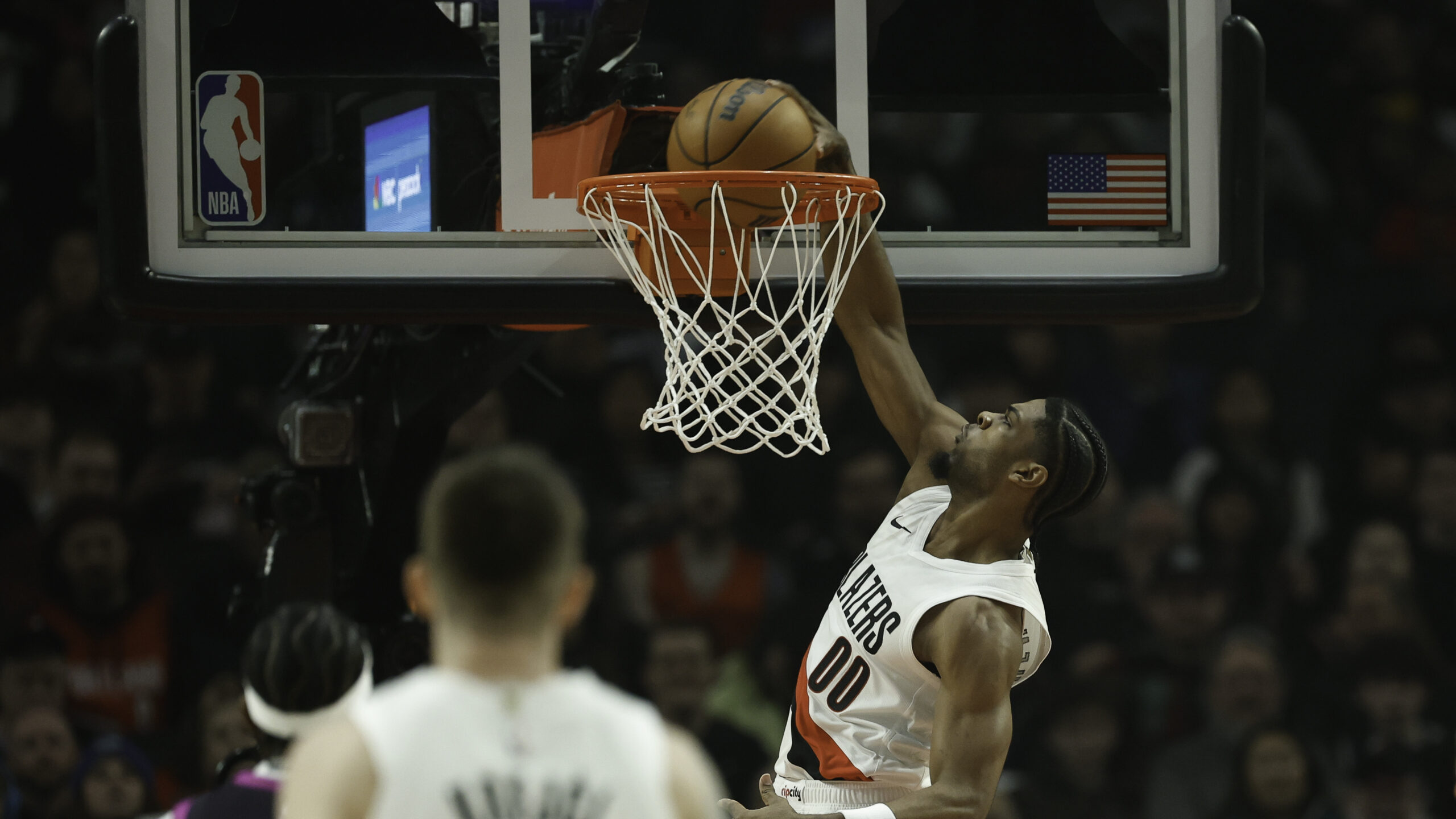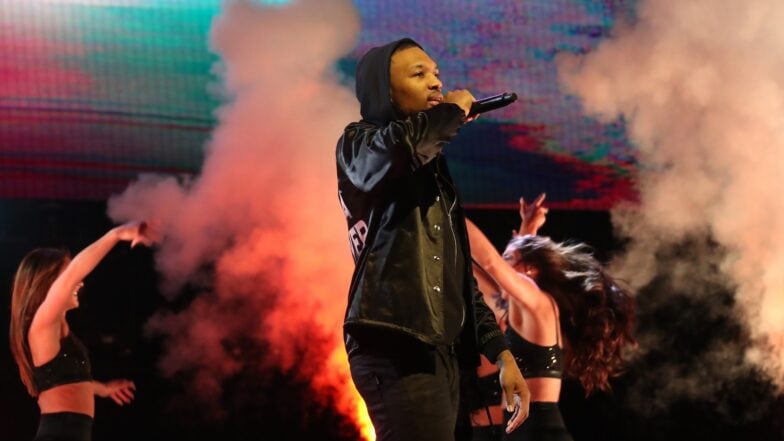
Portland Trail Blazers, Damian Lillard aka Dame D.O.L.L.A performs before the 2020 NBA All-Star AT&T Slam Dunk contest.
Editor’s Note: Read more NBA coverage from The Athletic here. The views on this page do not necessarily reflect the views of the NBA or its teams.
***
Philadelphia 76ers forward Kelly Oubre Jr. spends much of his free time recording hip-hop music under the moniker t$unami. He released a track during this year’s All-Star break.
In that track, he proclaimed the late actor Paul Walker might be his father — which is a wild line — but that’s besides the point. Oubre released his track, and barely anybody batted an eye.
Thirty years ago, an NBA player dropping a hip-hop track during the All-Star break would be big news.
In the 1990s, Shaquille O’Neal paved the way. His desire to make a career in rap music made it possible for Oubre to exist in the sphere. O’Neal opened the door. Later, Damian Lillard ran through it with a talent for the mic, arguably not seen before or after by an NBA player MC.
And because of that, O’Neal and Lillard are trailblazers.
“Those two made it OK for us basketball players to be rappers and to pursue rap,” Oubre told The Athletic. “Before Shaq, and even with Dame, nobody really took us seriously. We’re NBA players. We play basketball for a living. But we still like to do other things as well.
“Shaq and Dame made that possible. They paved the way for a lot of us. It’s still hard for us, but they made it easier.”
O’Neal made history in the summer of 1993. Although a Hall of Fame-level career that later spawned four NBA titles and three NBA Finals MVPs was already underway, a hip-hop career still relevant in 2026 began with an interview, a phone call and a trip to a recording booth.
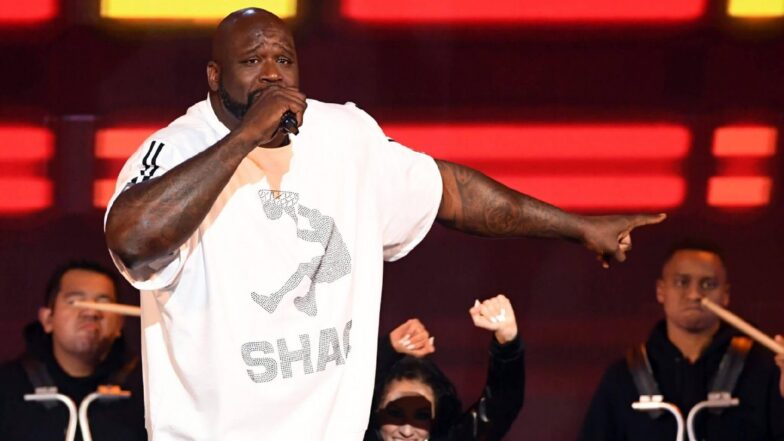
Shaquille O’Neal has been a hip-hop performer since the early 1990s.
The song was “What’s Up Doc? (Can We Rock?)” by Fu-Schnickens, one of the popular hip-hop groups of the early 1990s. They were known for their lively posse cuts, unique style and vivid production. Shaq was a fan. He also had an affinity for rap, an interest in getting into the rap game and a platform as one of the best young basketball players in the world.
What we didn’t know then was that O’Neal wasn’t a curiosity. He really was a hip-hop artist. He, like others of this ilk, would experience the jeers and the condemnation. Basketball players always wanted to be rappers. During that time, hoopers weren’t accepted as rappers.
One verse from Shaq helped change that.
“Forget Tony Danza, I’m the boss / When it comes to money, I’m like Dick DeVos.”
With one line, he referenced a popular TV sitcom actor from the era, turned it into a perfect metaphor and then told us he had as much money as the DeVos family that owns the Orlando Magic. The Magic became O’Neal’s first NBA team when they drafted him with the first pick in 1992.
More than two decades later, Lillard, under the moniker Dame D.O.L.L.A. (which stands for Different On Levels the Lord Allowed), released his first studio album, “The Letter O.” The defining track was “Wasatch Front,” an underrated storytelling journey chronicling his time playing for Weber State University. He talked about his matriculation from Oakland. He also talked about his infatuation with the women on campus and how that initially held him back from maxing out his basketball ceiling.
He talked about his sense of urgency to make something of himself on the basketball court to provide for his family. He also talked about how emotional it was for him to become good at a Big Sky Conference school to make the NBA.
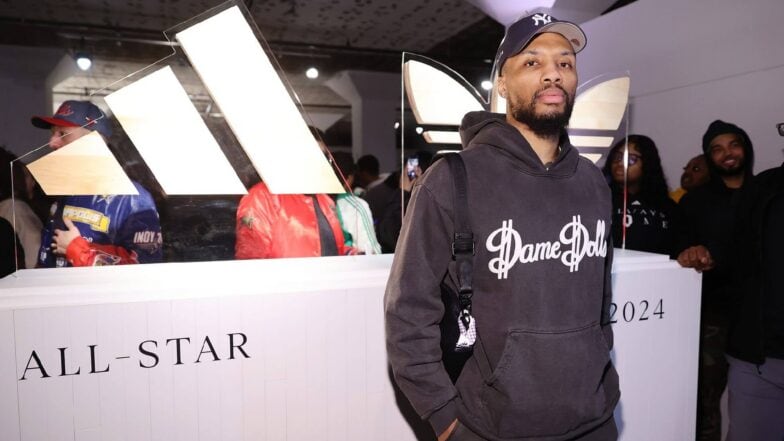
Damian Lillard raps under the moniker Dame D.O.L.L.A.
As a lifelong hip-hop head, two lines on that track still resonate with me.
“The Jazz up the road, I wanna play for Jerry Sloan.”
Lillard’s hook on that track was top-notch. It drew you in. And for Utah Jazz fans who needed to cling to any piece of hope they could find in that time, hearing Lillard say that was like an oasis in the desert. It gave them the thought that Lillard, considered one of the best point guards of this era, would one day head to Utah in free agency — elite free agents almost never head to Utah.
“I’m in the lab, let’s work that dribble jab / If I get this down, I’m getting 20 at the half.”
How many times have you watched Lillard hit a defender with a dribble jab, create separation and hit a 3-pointer? That bar perfectly encapsulated his hip-hop and basketball skills.
“Wasatch Front” was a defining moment for Lillard. “What’s Up Doc? (Can We Rock?)” was a defining moment for O’Neal. When we talk about hip-hop meshing with basketball players, those two provided the blueprint.
The list is longer than some may assume. There was Cedric Ceballos in the early 1990s. Gary Payton, Chris Webber and Allen Iverson all dabbled in the genre. The late, great Kobe Bryant put out a memorable collaboration with R&B superstar Brian McKnight, “Hold Me,” in 1997.
Ron Artest put out an album in 2006. And in today’s era, Oubre and Marvin Bagley III are serious about the craft.
Oubre has been making hip-hop music for six years. He’s an example of why the tree started by O’Neal and Lillard is impressive. Those two are considered more mainstream and traditional. Oubre’s lane is a lot more alternative hip-hop.
His real inspiration in the genre is Travis Scott. Oubre and Scott both grew up in Missouri City, Texas. Scott’s defining project is “Astroworld,” one of the biggest albums of the last decade. It’s one of Oubre’s favorite albums.
“It’s cool to see how much he has grown and how far he’s come,” Oubre said of Scott. “He was someone who wasn’t as well-known or popular as a kid, and he fought through a lot to get to where he is today. It’s just really cool to see how much he has accomplished.”
Rap is a difficult genre to break into, and it’s even more difficult to be respected, particularly as a basketball player.
The criticism of O’Neal in the 1990s was vast — and he got it from both sides. Rappers initially thought of him as a carpetbagger, not a serious artist. Basketball pundits said his rap and acting took away from him reaching his ceiling as an NBA player and that he didn’t take the sport seriously. The fact that he wanted to rap and act was proof of that.
In 2023, O’Neal and Lillard both appeared on “Shaq & Kobe (Remix),” a Rick Ross and Meek Mill track. It put together the two guys who helped make the intersection of hip-hop and hoops possible.
“Dame is tight,” hip-hop legend Chuck D of Public Enemy said. “Dame Lillard gets it. He understands the fine line, and plus, he comes from Oakland. When you listen to E-40, he’s got a balance of stuff. He probably grew up with that.
“Dame’s got a way to have a new style and some ethics, and he don’t get too crazy with it. If he’s gonna get crazy, he will be clever enough with his bars to kind of make it permissible.”
O’Neal has released five studio albums. One of them, “Shaq Diesel,” went platinum. Another, “Shaq Fu: Da Return,” went gold. His track “Biological Didn’t Bother” was a terrifically told story about the absence of his biological father from his life. It also gave a glimpse into what kind of father he would later become.
What made O’Neal shine, however, was his collaborations. The list of artists he worked with in that era is long and elite. He worked with Phife from A Tribe Called Quest. He worked with EPMD, one of the best rap groups ever. He worked with DJ Quik, Ice Cube, Black Thought, Peter Gunz, Method Man and RZA. He has also worked with Nas and Jay-Z.
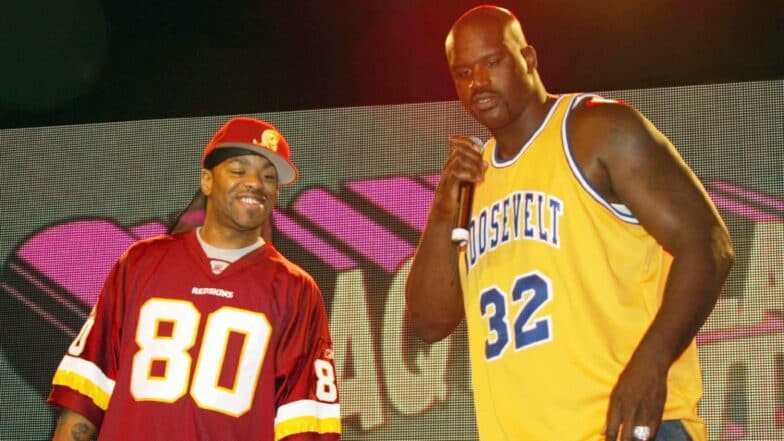
Shaquille O’Neal teamed up with Method Man of the Wu-Tang Clan during an event benefiting youth mentoring programs in 2003.
Part of the musical success was name recognition. O’Neal, by the mid-1990s, was one of the best basketball players in the world. He lived in Los Angeles from 2000 to 2002 and led the Lakers to three consecutive NBA titles.
“What’s Up Doc? (Can We Rock?)” gave O’Neal a platform that other rappers wanted to take advantage of. That, and his motivation to take his career seriously, led to some amazing collabs with some of the best artists in the world at the time. His pinnacle was “You Can’t Stop the Reign” with The Notorious B.I.G., one of rap’s greatest lyricists. The breakdown of this track is fascinating because O’Neal made Biggie work on the track and actually held his own. His second verse was particularly good.
“Who wanna test it, foreign or domestic / No matter (uh) where you’re from, I’m not the one you wanna mess with.”
O’Neal announced with that line that he was there to compete with Biggie and that he wasn’t going to allow Biggie to wash him on the track. Biggie’s second verse was ridiculously good, but the fact that O’Neal made Biggie reach into his bag and show some effort was a real accomplishment.
As a result, the two produced a terrific track, one that showed hip-hop fans an example of what can happen when a basketball player is actually good at the rap game.
What made O’Neal so good was his entire package. He was extremely charismatic. He brought excitement to almost any track he was on. He gave songs energy. And, he wasn’t afraid to try different things.
He did live performances and etched himself into the mainstream of hip-hop. He made tracks for multiple movies. He beefed with people through his lyrics.
In “What’s Up Doc? (Can We Rock?),” he took a shot at the two people he was closely compared to during his college basketball years. It was a clear diss but done in a unique and clever way that is still discussed more than 30 years later.
“Now who’s the first pick? Me, word is born’in / Not a Christian Laettner. Not Alonzo Mourning.”
That’s one of the best lines in the history of hip-hop. Laettner, if you remember, was given the final spot, reserved for a college player, on the 1992 Dream Team that went on to win Olympic gold in Barcelona. Many thought that spot should have gone to O’Neal, who was a monster at LSU. Many also compared the three players and who should have been the No. 1 pick.
O’Neal was a good lyricist, but not a great one. Lillard is a great lyricist. Flow, metaphors, versatility — Lillard has it all.
His willingness to dip his toes in so many waters is how the hip-hop world found out about his talent. Over a decade ago, he performed a freestyle on “Sway in the Morning” and impressed everyone when he started rhyming. Lillard found his groove and delivered excellent metaphors, effortlessly flowing through changing beats. It was special stuff.
Lillard’s song “GOAT spirit,” created during the COVID-19 pandemic, was an updated storytelling of his life and some of his struggles with the Portland Trail Blazers. He talked about handing his legacy to his son. He spoke of uplifting his community. Raphael Saddiq of Tony! Toni! Toné! fame laced the hook on that track. Lillard has also worked with artists like Snoop Dogg and Lil Wayne.
What’s the inverse? What’s the best example of a hip-hop guy who can hoop?
The answer is obviously Master P. He was good enough that he actually played a few preseason games with the Toronto Raptors, and he scored in a preseason game. He’s had multiple children go on to play Division I basketball. Mercy Miller is currently playing for the Houston Cougars and is in Kelvin Sampson’s rotation.
Will Smith is also a good example. He was a decent hooper while being a superstar rapper and an actor. Quavo, from Migos, is a good point guard. 2 Chainz played college basketball. Dave East is one of my favorite artists, and he was a Division I basketball player as a shooting guard. Cam’Ron was once all-city in New York out of Manhattan Center.
In terms of NBA players and hip-hop, O’Neal and Lillard showed the way and paved a path that should stay open. Both endured criticism, yet they kept going and, as a result, achieved greatness in more than one career field.
That’s what hip-hop is all about. It’s inclusive. And it’s made for differing personalities and talents.
***
Tony Jones is a Staff Writer at The Athletic covering the Philadelphia 76ers and the NBA. A native of the East Coast and a journalism brat as a child, he has an addiction to hip-hop music and pickup basketball, and his Twitter page has been used for occasional debates concerning Biggie and Tupac. Follow Tony on Twitter @Tjonesonthenba