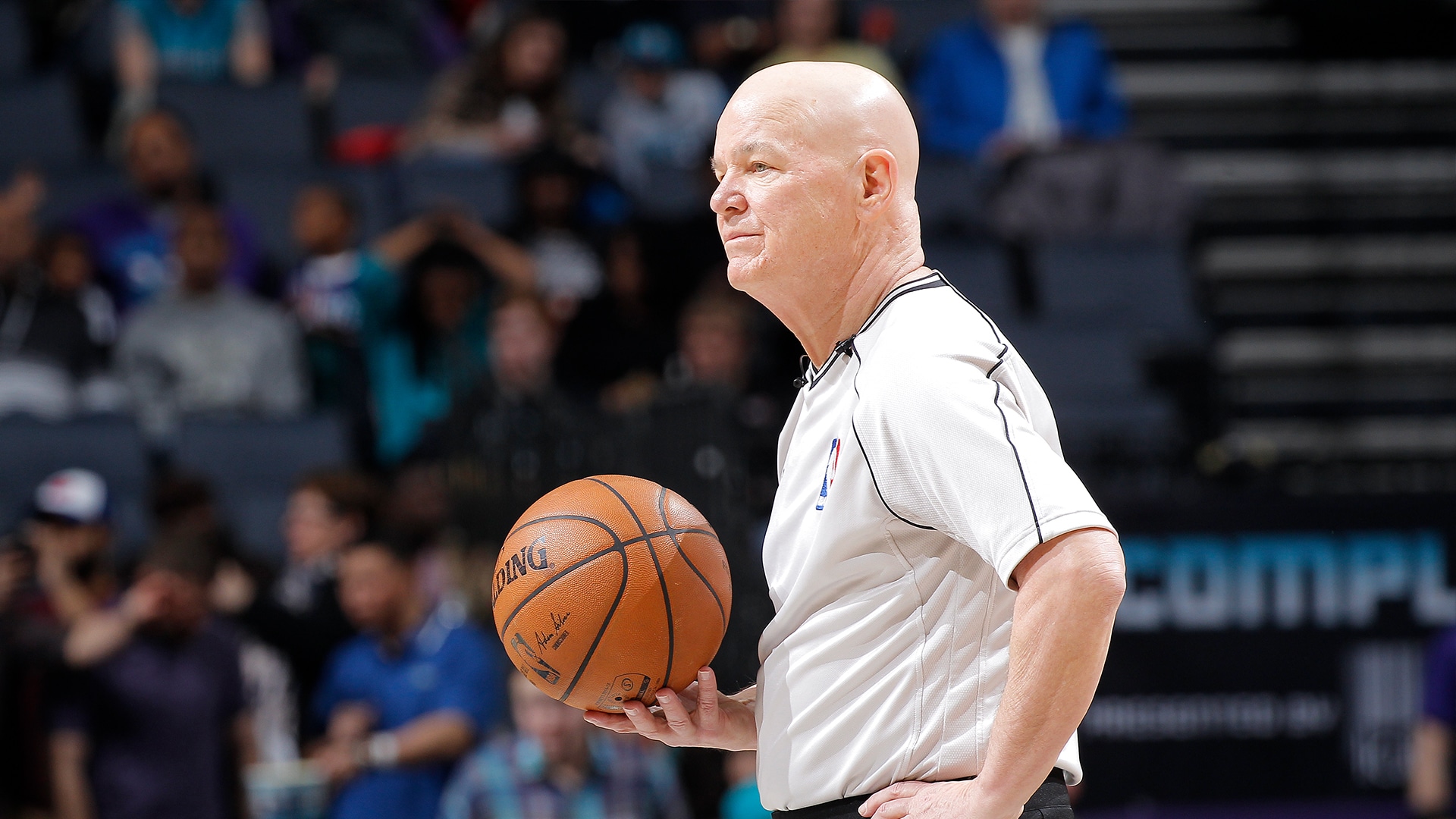
Joey Crawford credits watching his father, Shag, as an MLB umpire while he was growing up with his love for reffing.
Joey Crawford went into the family business, and for 49 years, business has been good.
And crazy. And demanding. And wild, fun, nerve-wracking, heavily scrutinized and everything else that goes into the officiating of major league sports events.
His late father Shag was famous as an MLB umpire for 20 years. His older brother Jerry was an umpire, too, working in the big leagues from 1976-2010. That Joey would join them as a game official never really was in doubt – the only question was the size of the ball, its color and stitches vs. seams.
“I always like basketball,” Crawford told NBA.com last week. “Growing up where we did [in Philadelphia], it was all around us. But my high school team was very good and I was not. I was mediocre at best. My father told me, ‘Joe, don’t get crazy here. Your future is a reffing job, not playing.’”
He chose wisely. Crawford will be enshrined in the Naismith Memorial Basketball Hall of Fame this weekend, a member of the Class of 2026 being celebrated in Springfield, Massachusetts.
“This is for my father,” Crawford said. “I wouldn’t have been refereeing if I hadn’t been born in that Crawford family and my father wasn’t a major league umpire. My brother, the same thing. This is such a great, great thing for my family.”
The 19th referee to be inducted in the Hall, Crawford was one of the longest-serving, most successful and in the view of some, most notorious ever. From 1977-2016, he officiated 2,561 regular-season NBA games and 374 more in the playoffs, including 50 Finals games. Since a bum knee forced him out 10 years ago, Crawford, 74, has served as a referee performance development advisor for the league, helping to train and evaluate refs across the NBA, G League, WNBA and international efforts.
“The majority of referees pursue excellence,” said Bob Delaney, retired ref and Crawford’s boss at league headquarters for a while. “Joey pursued perfection and would hold himself to that standard. Yet he wouldn’t hold another referee, his partners, to that.”
And it all began so long ago. Crawford was in first grade when Shag reached the major leagues. When he’d take his sons to sports events, he focused on the officials the way fans fixated on the competitors.
“Any time we went to a game or a boxing match, my father knew who was reffing or umping,” Crawford said. Later, even though he didn’t know anything about basketball, he would call me up and ask, ‘Why did you decide that the way you did?’”
Crawford was 18, working a CYO basketball game when Shag asked a friend Jake O’Donnell – who did double-duty as an American League umpire and an NBA ref in his early days – to scout out his kid. “He came to see me at Our Mother of Good Counsel on Rte. 30,” Crawford said. “I’ll never forget it.”
The Philadelphia region in which they all lived, trained and/or worked was famous, and remains so, as a veritable breeding ground for referees and umpires. What western Pennsylvania is to NFL talent, what the Dominican Republics is to shortstops, that’s what Crawford’s hometown has been to game officials. The list of NBA refs alone includes O’Donnell, John Vanak, Earl Strom, Jack Madden, Ed T. Rush, Mike Callahan, Ed Malloy and Crawford’s eventual mentor Joe Gushue. Six of those refs worked games in the 1978 Finals between Seattle and Washington, that’s h0w heavy the influence was.
“I used to hear from Red Auerbach once or twice a year,” said longtime NBA executive Rod Thorn, who served as supervisor of officials for 14 years and will be one of Crawford’s presenters at the Hall ceremony Saturday. “We’d be going into the playoffs and Red would say, ‘You can’t put those Philadelphia referees on our games!’ There was such a rivalry between the Celtics and the Sixers.
“I’d say, ‘Red, the best referees we’ve got are mostly from Philadelphia.’
Said Crawford: “You had an advantage because of where you lived. To this day, kids there are refereeing and then they watch tape. It has nothing to do with politics and who you knew, that being from Philly meant you got in the NBA. It meant you got good tutelage.”
After finishing at Cardinal O’Hara High School, Crawford refereed basketball while working at the post office. He married Mary, his wife of 55 years, and kept grinding in high schools and in the Eastern league (which became the Continental Basketball Association). Scouts noticed and Crawford was 26 when he joined the NBA, about the time the league added four teams from the ABA.
His early years were long on technical fouls, light on technology. The relentless video reviews that are such a part of daily duty for referees and their bosses in 2026 were non-existent or rudimentary at best five decades ago. Fortunately, Crawford had Gushue, who took a number of young officials under his wing during and after working in the NBA and ABA from 1961 to 1984.
“I’d be in my hotel room and the phone would ring, and it would be Joe Gushue,” Crawford said. “He’d say, ‘I just looked at the box score and saw three or four T’s. Tell me about it.’ Every person didn’t get that kind of teaching.
“When I would see Joe in the summer, he’d talk and I would listen. He’d tell me things like, ‘You might have been able to defuse that situation if you did this …’ Or ‘Did you call something cheap on the previous possession? That’s why Dick Motta exploded.’
“I use all his stuff today. But now we have the video to back it up.”
In any videos from Crawford’s games, he’s impossible to miss. He had a distinctive running style, with a little hop to get going and elbows tucked as he ran the floor in his choppy strides. His manner of doling out technicals was distinctive too, often using only his two index fingers, theatrically crossed.
He exuded pugnacity, as if he were about to lock horns with Billy Martin or Tommy Lasorda without dirt for them to kick on home plate. In a league of Labrador retriever refs, Crawford was all bulldog.
“Michael Jordan’s rookie year, my second year, Michael didn’t get called for a travel,” recalled Doc Rivers, a fellow 2026 HOF enshrinee. “I said, ‘I didn’t get that all as a rookie.’ Joey said, ‘You weren’t that good.’” I think we do miss a little of that [personality] these days.”
Crawford’s temper, determination to run his games and most of all avoid mistakes got the better of him at times. Even when he was whistling technicals to back up a younger ref in his crew, they added to his reputation. His 2007 episode with San Antonio’s Tim Duncan, ejecting him when Duncan was laughing from the bench, got Crawford suspended and left him mortified by his tightly wound demeanor.
“I was so aggressive and hot-headed that I was searching for middle ground where I could show my personality and still be effective,” Crawford said. “I had to find something because for much of my career, I didn’t like the way I was being perceived and how I was reffing.”
Said Delaney: “How he started, his style, would not be accepted today. But his self-reflection and his willingness to say when he was wrong was at the top.”
Crawford sought out a sports psychologist and got some anger-management training, and seemed to benefit immensely. That didn’t mean he lightened up on the standards.
“Joey wore his heart on his sleeve,” said Doug Collins, Hall of Fame coach and broadcaster. “You had to be careful – if you got too focused on him, he’d remind you to just ‘Coach your team!’ But he was a guy you loved to see, especially during the playoffs, because you absolutely knew he wasn’t going to be swayed by the crowd or where the game was being played. And he never took a play off.”
Referee Marc Davis, a veteran of 28 NBA seasons, met and first worked with Crawford back in 1999. “He was a phenomenal teacher,” Davis said. “His intensity was in direct proportion to his care for the game and his commitment to fairness. And he always cared about his partners.”
Always, Crawford tried to keep priorities straight: the game, his crew, then himself in that order.
“He was a terrific teammate,” said Thorn, who scheduled officials for the biggest games. “You could put Joe with anybody. Going into a playoff game, say, and you’re looking for refs to pair up – some guys’ personalities you didn’t want working together. But with him, I can’t recall one time anyone said, ‘Joe can’t work with X.’”
Top performers across all professions, certainly those with the drive and focus to reach a Hall of Fame, make sacrifices. Crawford knows that most of those came from his wife Mary, daughters Amy, Megan and Erin and their families through his career.
His speech has been written for weeks now. And the guy who always was harder on himself than any boisterous heckler ever could be seems finally to be enjoying this.
“I think I already exhaled,” Crawford said. “Is everything that I did OK? No, not really. But people recognize that I was a good ref and a good partner and a good employee. That means something to me. I’m really happy with where I’m at.”
Steve Aschburner has written about the NBA since 1980. You can e-mail him here, find his archive here and follow him on X.