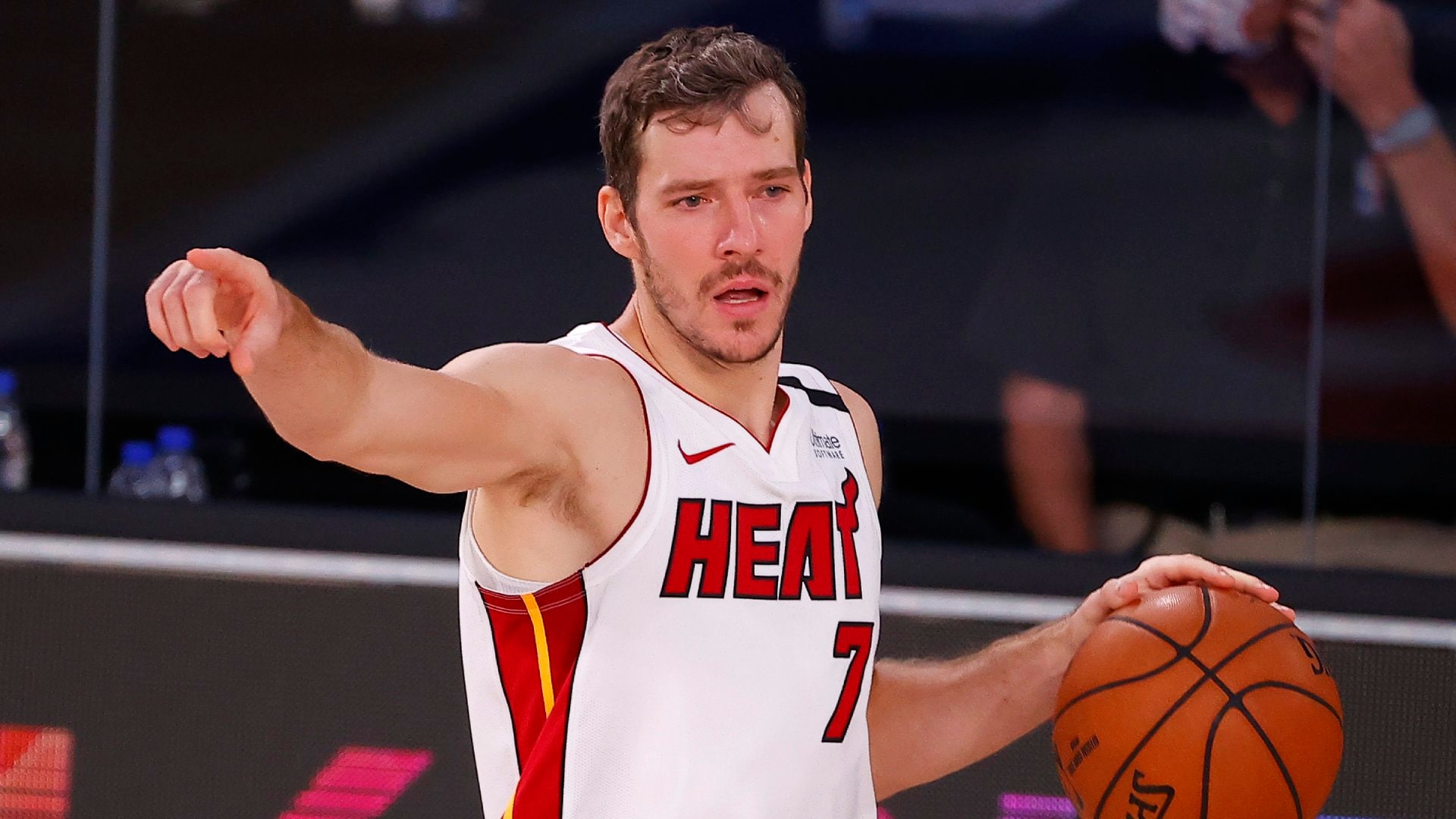
Goran Dragić played 15 NBA seasons and was crucial to the Heat reaching the NBA Finals in 2020.
For many, retirement means moving into another phase of life.
For former All-Star guard Goran Dragić, retirement’s next step is a move into the garage — sort of.
Dragić, who retired in 2023, says he intends to soon launch “Gogi’s Garage,” a podcast in which he will talk about a variety of topics.
“We’re going to talk about sports. Not only basketball, everything that’s going on … soccer, tennis, I can’t wait,” Dragić said. “It’s a lot of development. The set is all done, so we’re getting all the guests in line and hopefully we can start soon.”
After spending 15 seasons with seven different NBA teams, Dragić retired and said he did so in hopes of dedicating more time to his two “kiddos,” Mateo and Viktoria.
He made the All-NBA Third Team in 2013-14, the same season in which he was named Kia Most Improved Player, and made his lone All-Star appearance in 2018 (the first Slovenian player to do so).
The left-handed Dragić was the 45th overall pick in the 2008 Draft by San Antonio. He averaged 13.3 points and 4.7 assists per game in his career, and averaged 20 points in a season twice — in 2013-14 with Phoenix, and 2016-17 with the Heat. He played for the Suns, Heat, Milwaukee Bucks, Chicago Bulls, Brooklyn Nets and Houston Rockets in his career.
In a chat with NBA.com, he talked about his playing days, what “Heat Culture” means to him, the 2026 NBA Europe Games, the 2026 NBA All-Star Game format and more.
Editor’s Note: The following conversation has been condensed and edited.
NBA.com: Many of your teammates from your playing days (Shaq, Nash, Grant Hill, Dwyane Wade, Matt Barnes, Channing Frye, Udonis Haslem as well as Jarron Collins, Shane Battier, Luol Deng and others) have given broadcasting/media work or front office work a try since retiring. What interest level have you had in doing that kind of work?
Goran Dragić: I mean, I would love to be involved in the front office of a team. But when I retired, I kind of dedicated my time to my kids a little bit because I was away from home for so, so long. Now, what, I’m retired two years — one and a half — and, um, you know, I’m dedicating my time to my kiddos. But, yeah, I’m definitely thinking about it, what’s gonna be my next step. Slowly but surely, I’m making plans and trying to get back into the game, so to speak.
Did being on the OGs Podcast with Udonis Haslem and Mike Miller spark the creation of that podcast for you? What led to that?
A little bit … I had an awesome time on their podcast. First, I was a guest and then they called me to be a host because Udonis Haslem was traveling with the Heat. I kind of liked it a little bit. At that time, it was really free-flowing and I didn’t prepare myself because they called me one day before. I like to talk, I like to communicate, especially if we can have a good debate with my friends and cool guests, I think that’s pretty interesting.
Trae Young has been traded to the Wizards. In your career, you were traded four times … what would you say is the biggest challenge you deal with as a player as the trade deadline comes around?
I mean, the biggest challenge for me is it’s all in what kind of point of your career you are. If you have a family, if you have a kid, you know, I think that’s the toughest part. If you get traded, and the kids are going to school, and you kind of settle into the town that you’re play for and then, suddenly, you find out that you’re getting traded. I think that’s the most difficult thing because you have to organize your kids, your family and figure out how to move.
I got traded [to Houston in 2011] when I was in Phoenix. At that time, I was still young. I didn’t have family, I didn’t have kids, so it was much easier, you know, to move to a different city. My priority was just me. You have to get to know different people, a different organization, a different city, a different system of playing. And, you know, at the end of the day, it takes time to adjust those things.
But, you know, everybody loves basketball. Everybody wants to hoop and play, so in the end, you have to go through those things to be successful. It’s not easy, but at the same time, you know, you are playing basketball — the sport that you love — and, you know, it doesn’t matter where you’re playing.
As a point guard, is it a harder transition to be traded versus what players at another position go through? I would imagine as a point guard, you have to get to know your teammates …
Yeah, I agree, it’s really — I think, for a point guard — it’s a little bit tougher, because, like you said, you have to know the system. You have to know the players, who you’re playing with and where they like to receive the ball and how they like it. Then, you know, if you get traded in the middle of the season, that’s the hardest part because you have to fast-track to get into the system and try to, you know, figure out those things. It’s a little bit easier if you get traded in the offseason because you have a full training camp with the team, you can build with your teammates and your coaching staff and try to grow.
During the season, it’s a little bit harder because, you know, you have to do it on the go, it has to be faster, and everybody expects for you — right away — to play well and the team to function well with you on the court. But, you know, the most crucial point, I would say, is that you have to talk a lot. You have to be on the same page with the coaching staff, with the players. And I think communication is the biggest solution for that.
If you could replay one season with everything you know now, which one would you choose and why?
I never thought about it, but as a young kid, maybe I would approach the game differently. You know, maybe spend more time on other aspects of the game to learn and dedicate more time. I did practice a lot, but, you know, when you’re young, and when the vets are telling you some stuff, you just brush it off. You think: ‘It’s gonna come, I know how to do it.’ At that time, I’d maybe like to listen more and to accept more things that they were telling me.
The one thing in my career that I would like to go back and kind of do it all over again is probably the [2020] NBA Finals when I got hurt. Maybe to manage my injury a little bit differently … especially in the playoffs, maybe to listen to my body more and maybe to take some days off. Maybe that injury during the Finals would not have happened. I don’t know, it’s tough to say.
Did you notice anything different about Luka Dončić at EuroBasket 2025 in terms of his approach to the game, his habits or anything else?
Definitely, he was more vocal. I think he finally grew as a leader. We have to understand that when I played with him, he was still a young kid, 18 or 17 years old, and, you know, now he matured. I mean, we all know how talented he is and what he can do on the floor. But the one thing that he really improved: he became more vocal, that he was telling players in the locker room and timeouts, or on the court where he wants them — how he sees the game.
It’s tough … on the national team he needs a little bit more help. Our situation now, we don’t have a lot of players and we are changing generations. So, hopefully in two or three years, he’s gonna have some help and we’re gonna be better.
The biggest improvement definitely was how in shape he was, how he came back to the Lakers and EuroBasket and finally started taking care of his body. If he wants to play long and have longevity, that’s the way to go.
What are your impressions of Dončić’s season to date with the Lakers?
He looks better, faster … more agile. He puts effort in defense a little bit more and I think that’s going to help, especially in the playoffs. Because we all know in the playoffs, teams will be preparing. They will [try to] expose you and attack every weak link and I think he’s going to do well this season. The Lakers have had a lot of [players] in and out this season — LeBron [James] was hurt, then Luka was out, then [Austin] Reaves was out — so they have a lot of moving parts. When they get healthy and everybody’s back, I think they’re going to do well. I have to admit, JJ Redick is doing an amazing job (as coach).
There are two games in Europe next week, so this seems relevant: As someone who helped pave the way for modern international guards, how do you see the evolution of European talent shaping the NBA today?
I mean, it’s unbelievable. You know, how much talent we got in NBA right now. Let’s say internationally, not only from Europe, but, you know, just to see how European players develop the game and how crucial they are for the NBA right now.
You know, the last, what, five MVPs, they’re all from Europe or are international. And it’s unbelievable how the game became global. You know, maybe back in the day, especially here in the States, people didn’t, um, give a chance, you know, to European players. I look back in the day to Dražen Petrović, you know, he was one of the best European players and, and, you know, we have to be grateful for those players because they paved the way for me. I mean, Arvydas Sabonis, Šarūnas Marčiulionis, Toni Kukoč, [Vlade] Divac, Peja Stojaković … all those guys make it possible for me that I could play. Now that I’m looking at, you know, the league right now, it’s unbelievable. I mean, you know, you have so many franchise players, the international players, and it’s unbelievable.
You mentioned on The OGs podcast last year what you thought of “Heat culture.” What was your experience with “Heat culture,” and was there a moment or instance that showed the difference between Miami and other organizations?
I love it. I love it. You know, ‘Heat Culture’ is my DNA, so to speak, because that’s how I grew up. I played for a lot of Serbian coaches, and they were always tough. They had that like, military mentality, you know? When I played for the Phoenix Suns and for other organizations, it was a lot more loose. Players had a lot more — how would I say it — freedom and they can do whatever they want. But here in Miami, they are strict, but at the end of the day, you have to be a professional. If they’re paying you so much money, their motto is: you have to be in the best condition.
You have to go through a really strict training camp and, you know, personally, that was amazing because that’s how I like to approach things. That’s why they like to say, you know, ‘Miami culture is not for everybody.’ So, man, I love it, you know, because they hold you accountable [and] to be a professional.
You made your first (and only) All-Star team in the 2017-18 season in what was the first “captains” game and were on Team LeBron. What was that experience like for you after years of waiting to make it?
I mean, it was great. You know, I always dream about that, I always wanted to play the All-Star Game. I had a couple of good seasons before that, probably in 2014 when I was All-NBA and the Most Improved Player. I should make that year. But, you know, it is what it is, it went the other way.
It’s a huge honor to be the first-ever Slovenian in the All-Star Game. You know, for me, that was a big deal … I’m really proud of that moment. That was kind of, my goal, my dream, and I finally achieved it in 2018. Now you have Luka, who is there every year. It’s too easy. It’s too easy for him (Laughs). But that’s cool. That’s awesome because, now you can see, at least from my standpoint, how hard it was just to play at that high level and now you can cherish all those great, great ones — Kobe [Bryant], Giannis [Antetokounmpo], Luka, Michael Jordan, D-Wade, LeBron James — how tough it is just to stay in that high level all these years and to be the best.
What is the best thing, to you, about this year’s All-Star Game format?
I was kind of hoping that they’re going to change [the format], and finally, I think it’s going to be really exciting. You have so many international players and you have a good U.S. team, so it’s going to be really interesting to see. You know, we all discussed for many, many years how the All-Star Game is not good, how everybody is not playing defense and it’s just [everyone] shooting and [its like] a pickup game.
Now, hopefully, it’s gonna be a little bit different. I know the international players — they want to prove that they can win. They’re gonna have a little bit of a chip on their shoulders, so hopefully, it’s gonna be an interesting game. On the other side, I understand that, you know, it’s a long season and nobody wants to get hurt. So, you know, probably some players are gonna be cautious, but we’ll see.
Which player or players could be slept on for spots on the World team and shine in L.A.?
I think [Deni] Avdija can make a spot, especially with how he’s played this season … he’s putting up big numbers in Portland. Maybe Nikola Vučević or Ivica Zubac … it all depends, you know? Who gonna be in the starting five? Probably that’s going to be Shai [Gilgeous-Alexander], Luka, Giannis, [Nikola] Jokić and then maybe [Alperen] Sengun, I don’t know. And then the rest you have, what, seven spots left?
It depends on who you’re gonna need on that team. But yeah, it’s gonna be interesting, man. There are a lot of good players in this league. So, like every year, probably somebody is not going to make it that deserves it, but there are only 12 spots available.
What is an aspect of your game fans or others may have underappreciated?
How tough I was, I think. You know, I played through a lot of injuries … most of the games, it’s such a grueling, long season. I really [tried] to play all my games … most of the games I was hurt, but I wanted to be on the floor and to help my teammates and to be there for them.
I think that’s the main aspect. If I hear ‘He was a good basketball player, but he was tough.’ I think that’s a good compliment to have. Maybe that was not good, too, because most of the games I was playing hurt. So, then, I was not fresh for the playoffs. You know, it’s a good and a bad thing.
I remember most of the time, when I would be hurting, I would talk to my agent. And my agent was telling me, ‘Take the game off because, you know, you need to get rest and to heal that injury.’ And I said, ‘Yeah, I will.’ So I get to the arena, and Spo [Erik Spoelstra] would ask me, ‘G, how are you feeling?’ And I said, ‘You know, I’m not feeling so well tonight. But you know what? I’m gonna go out, warm up, and see how it is.’ And then, you know, every time I went out there and warmed up, every time I got back, I’d say ‘Spo, I’m playing.’ (Laughs) … It was always like this.
I think I know which way you’re going to go with this, but just curious: If you had a Kia MVP vote this season, who would get it and why?
I will give it to Wemby [Victor Wembanyama]. I would pick Luka, too. Luka is gonna get MVP votes, definitely, and probably, Wemby, too. But I’m just so fascinated with Wemby. I mean, I just watched them the last few games … he’s on a minutes restriction and he’s putting up crazy numbers, and, you know, he’s a two-way player. He locks down the paint for everybody. He’s deadly on offense. He’s, what, 7-foot-3? He can dribble the ball, he can pass, he can shoot. I mean, that kid can do everything. I’m just impressed with his maturity, especially at that young age — he’s 19, maybe? — just how mature he is, it’s unbelievable to me. I’m really fascinated with him.