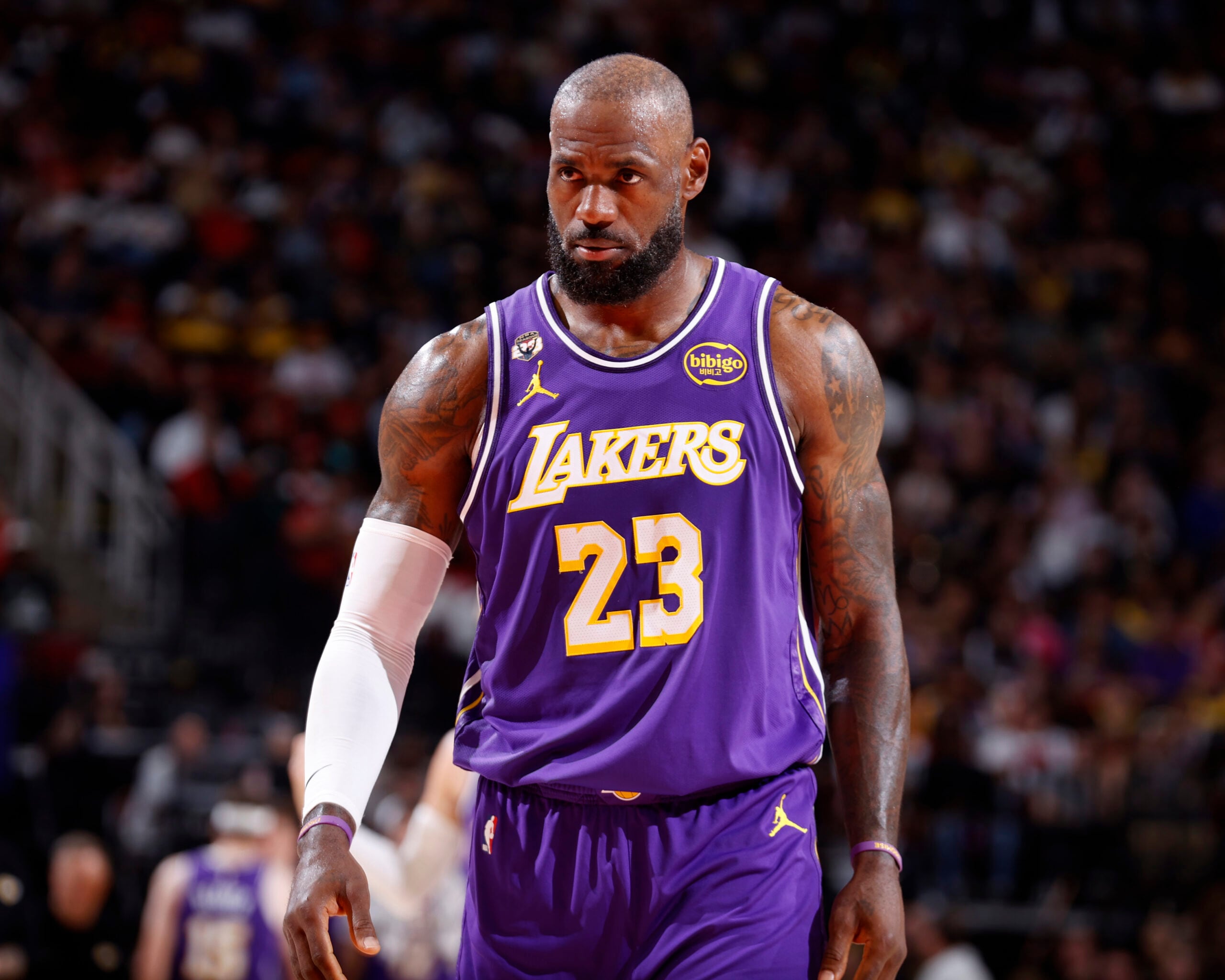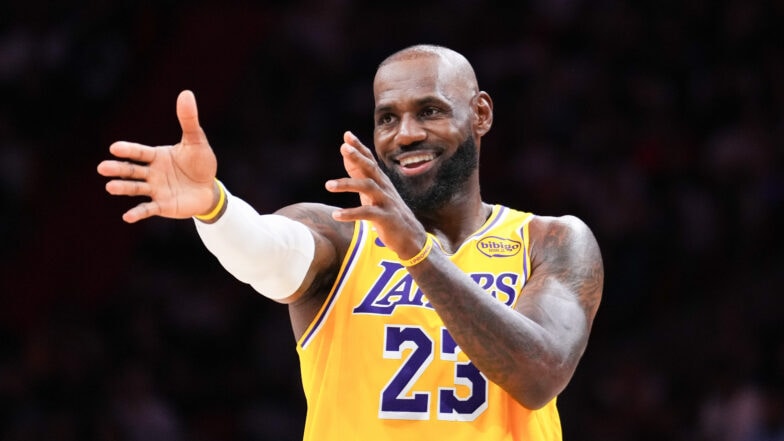
LeBron James reacts against the Miami Heat during the third quarter at Kaseya Center.
Editor’s Note: Read more NBA coverage from The Athletic here. The views on this page do not necessarily reflect the views of the NBA or its teams.
***
As Lakers fans undoubtedly know, that scene has hardly been uncommon the past two years. While L.A.’s late-game mojo didn’t carry over into Detroit on Monday, the Lakers are an astounding 21-7 in games decided by five points or fewer this season and 22-7 in games NBA.com defines as “clutch” (games that were within five points in the last five minutes) after going 23-16 in similar games a year earlier.
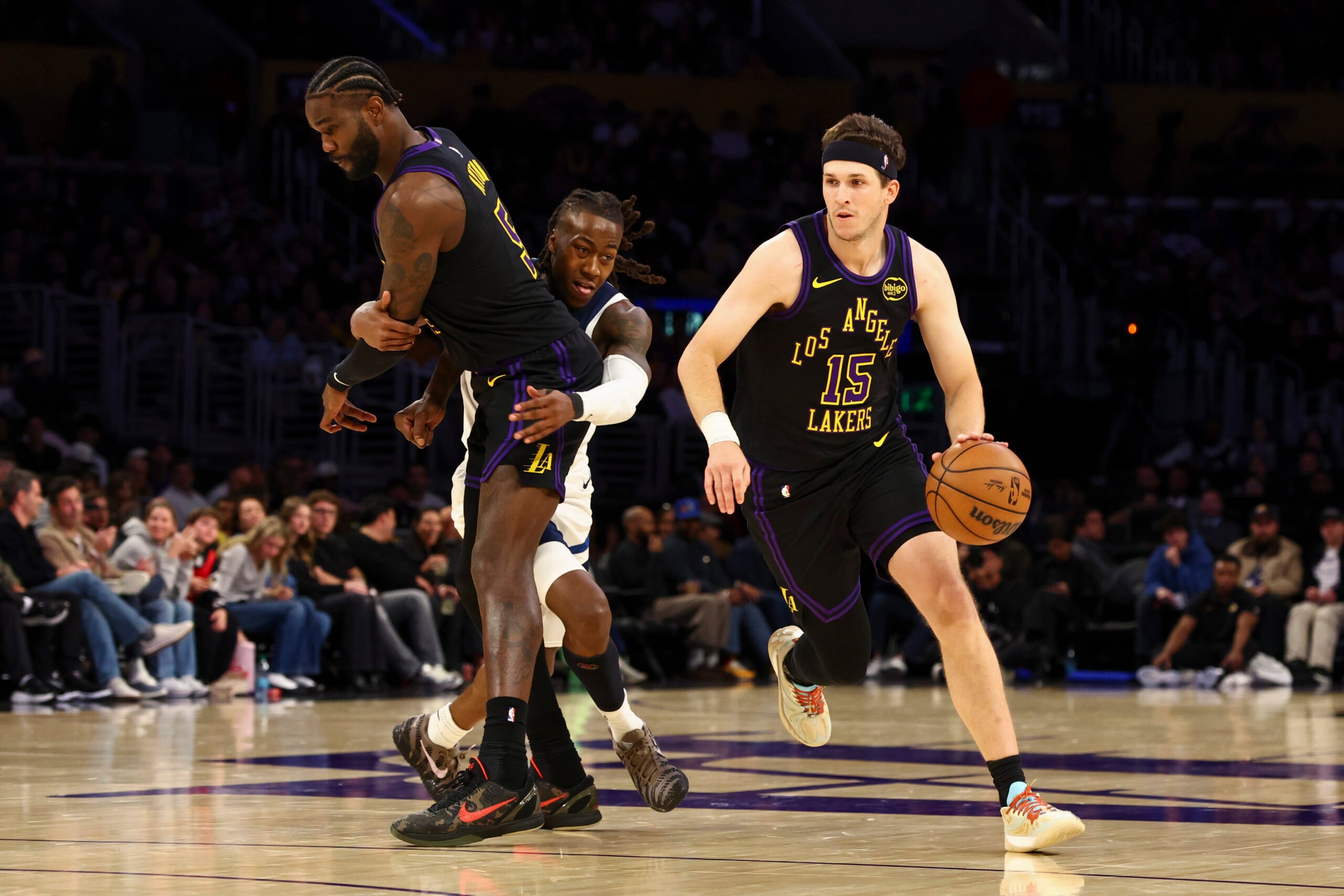
The Lakers’ recent nine-game winning streak, in particular, got a big narrative boost thanks to a pair of unlikely clutch wins. Look, 7-2 in a tough stretch of schedule is nice, but nine straight is news. Fittingly, the Lakers won one game where they successfully intentionally missed a free throw at the end (Austin Reaves’s perfect plunk off the front rim against Denver that allowed him to make a game-tying shot) and another one where they unsuccessfully intentionally missed a free throw (Deandre Ayton’s line drive caromed straight into the floor and to Orlando seconds before Kennard’s heroics).
So yes, the Lakers are an odd team, much as they were a year ago. They have an A-list superstar in his prime and an all-time legend who still delivers, and surround it all with another 20-point scorer in Reaves and the pedigree of being one of the league’s marquee franchises.
On the other hand … they just haven’t been that good for most of the year. The Lakers are 46-26 entering Wednesday’s visit to Indiana, but have the point differential of a team that’s 39-33 — a record that would only be seventh in the West and tied for 14th in the entire NBA.
Injuries have been part of the story — somehow, some way, Jake LaRavia is second on this team in total minutes — but the Lakers aren’t the only team in the NBA to have a player miss a game. Their three difference makers have missed 69 games between them, but many of their rivals in the standings can tell similar sob stories.
Moreover, the recent run of success feels a lot less fluky than some of Los Angeles’ early-season escapes. The Lakers are only 25-19 in “non-crunch-time” games this year, which is usually a better indicator of a team’s quality and thus a not-great one for L.A.’s postseason viability, but nearly half the wins have been since the All-Star break.
In fact, the recent non-clutch games may be a much better reason to believe in Los Angeles’ legitimacy than the Houdini acts against Denver or Orlando. While the nine-game winning streak was greased by a couple of unlikely, fantastic finishes that may be hard to conjure up on demand, the Lakers are also 10-1 in their last 11 non-crunch time games. What that means, basically, is that they are winning games easily quite often, and rarely losing the same way — the polar opposite of where they were the first half of the season, and the biggest predictive “tell” of a team’s true quality.
Since getting pummeled by Boston 111-89 in their second game out of the All-Star break, the Lakers have not only won the non-crunch games, but won them against good teams. This is an important distinction, as we’ve seen the last-season schedule distort many other teams’ results (greetings, Hawks fans!), which are padded by routs of the league’s eight shameless tankers.
The Lakers, however, haven’t been fattening up on the underclass. The Sacramento Kings and the Chicago Bulls are the only two teams they’ve played in this stretch that have given up on the season. L.A.’s stretch of non-clutch wins includes a pair in Houston, one at Miami, and surprisingly easy home wins against the New York Knicks and the Minnesota Timberwolves. Since that game against Boston, they have yet to lose by more than seven points.
I’m dancing around the real topic here, so let’s take a more direct line: These results are pretty important as far as the “Are they a contender?” question that hangs over the Lakers, for this season and as they plan their future.
On multiple levels, their recent run of play has turned a hard “no” into a “maybe?”
Long-time readers are familiar with me saying this, but I’ll go ahead and say it again: If you aren’t one of the top-three seeds and haven’t won at least 52 games, your odds of winning a championship are infinitesimally small.
We’ve had only one of the last 48 champions meet that criteria (the 1996 Houston Rockets), and with at least 10 playoff teams in each of those seasons that were below my cut line, it means any individual team in this bucket is about a 1-in-400 proposition historically.
Thus, the goal for any wannabe contender is to finish the regular season outside that bucket. In fact, three weeks ago, I wrote dismissively of the Lakers’ chances for that very reason.
The win streak changed that trajectory. Historically, the part about “winning at least 52 games” is important — top-three seeds with fewer than 52 wins have a long, proud history of getting thrashed in the playoffs, including a preponderance of the first-round upsets involving second and third seeds. Astute readers will note that the list includes last year’s L.A. quad, a No. 3 seed but one with just 50 wins, and one that was excused in five games by Minnesota in the first round.
Welp … after winning nine straight in a tough stretch of schedule, the Lakers have suddenly banked 46 wins, which means six more gets them to the magical 52 threshold. From here, the road to 52 doesn’t seem difficult — the team has five games left against tankers (including the upcoming Murderer’s Row of Indiana-Brooklyn-Washington) and six at home. While it also plays the mighty Oklahoma City Thunder twice, L.A.’s path to 52 is achievable solely by winning the five gimmes and defeating a reeling Golden State team, even if the Lakers lose their other four games.
With a win total of 52 or above, the Lakers are almost assured of remaining in a top-three seed as well. ESPN BPI projects the Rockets and Wolves to reach 49 or 50 wins, with the Nuggets grabbing 51. Additionally, the Lakers won the tiebreak against all three teams and would win any multi-team tie; a team like Denver has to pass them, not just catch them. (That intentional miss by Reaves two weeks ago looms quite large here!)
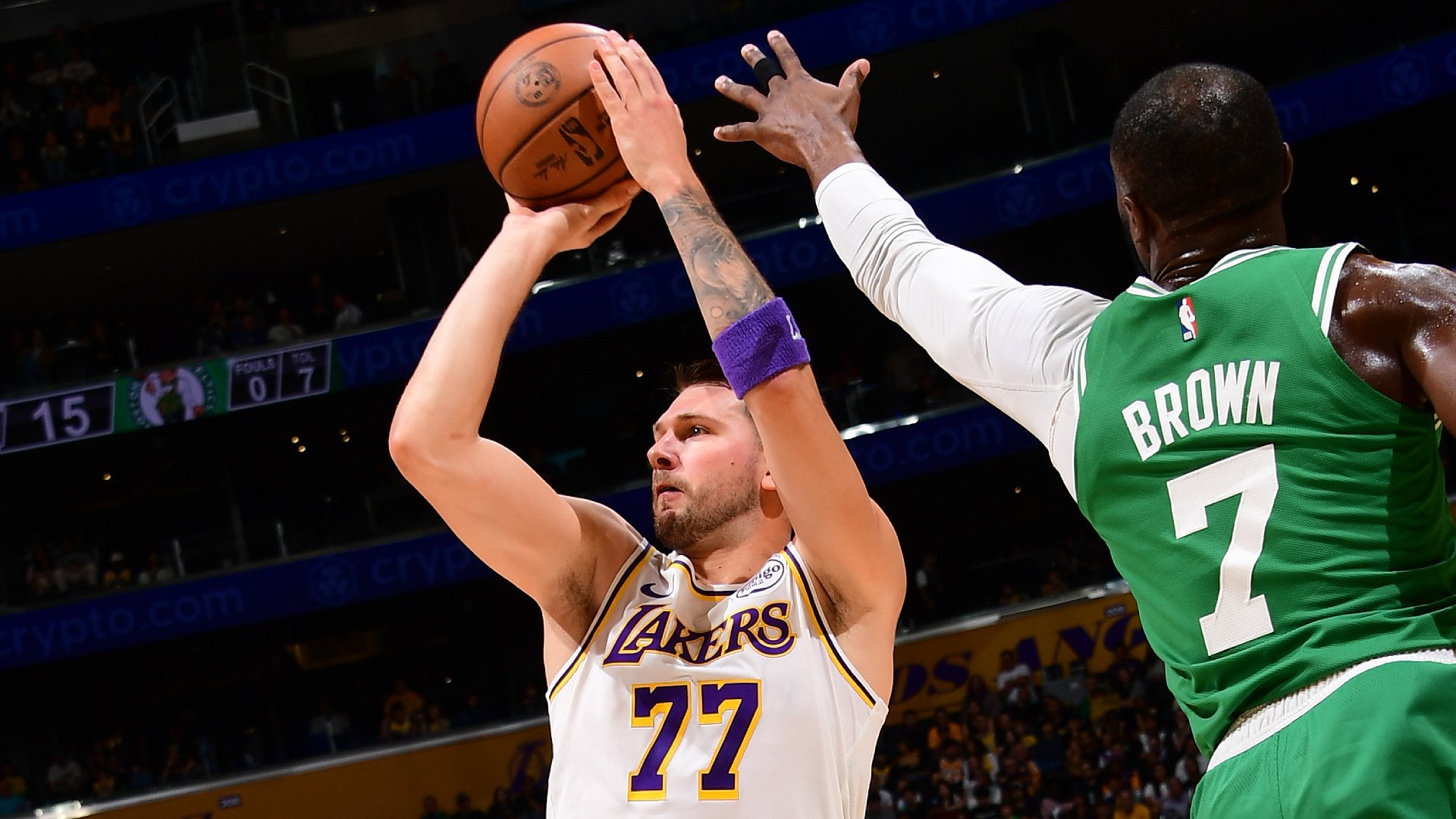
As others have written, the Lakers’ improving chemistry among their three perimeter stars has played a big role in their surge, and the timing doesn’t seem accidental. As I noted a year ago, incorporating an extremely high-usage player such as Luka Dončić is difficult enough in the offseason, let alone mid-stream after the shocking trade from Dallas last February. It seemed like it took a full year before L.A. finally struck the right balance with LeBron James and Reaves. Between that, the Kennard trade and some improved health, their move up the West food chain seems entirely believable.
Of course, at this point, I should probably discuss the elephant in the room. If we’re going to talk euphorically about the Lakers returning to the NBA’s contender class, we also must include an orca-sized pillar of salt. The Lakers are playing their best basketball of the season, by far, and yet even in that stretch, the two teams they must beat, the Thunder and the San Antonio Spurs, have still been better.
Oklahoma City has won 12 in a row and gone 15-1 since the break, with the only loss coming at Detroit in a game that Shai Gilgeous-Alexander, Jalen Williams, Chet Holmgren, Isaiah Hartenstein and Alex Caruso all missed. San Antonio, meanwhile, is 22-2 in its last 24 games with 16 double-digit wins. Scary.
Historically, plenty of teams that technically had “contender” metrics were still obliterated in the playoffs because they ran into a buzzsaw like Oklahoma City or San Antonio. Of the six teams that seem likely to meet my contender criteria this season (three in the West, plus Detroit, Boston and New York), only one can win the title. Of those six, the Lakers unquestionably would have the worst odds in the group.
What this recent run of play does do, however, is at least put the Lakers in the Jim Carrey zone — yes, I’m saying there’s a chance. It didn’t seem that way a few weeks ago.
***
John Hollinger’s two decades of NBA experience include seven seasons as the Memphis Grizzlies’ Vice President of Basketball Operations and media stints at ESPN.com and SI.com. A pioneer in basketball analytics, he invented several advanced metrics — most notably, the PER standard. He also authored four editions of “Pro Basketball Forecast.” In 2018 he was honored with the Lifetime Achievement Award at the Sloan Sports Analytics Conference. Follow John on X @johnhollinger.