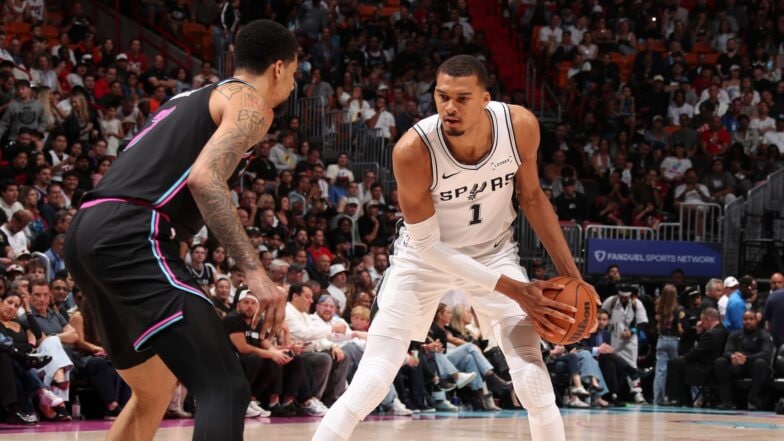
Victor Wembanyama is as capable of expressing his MVP case in a debate as he is on the court.
Editor’s Note: Read more NBA coverage from The Athletic here. The views on this page do not necessarily reflect the views of the NBA or its teams.
***
MIAMI — Keldon Johnson has a problem. He’s actually kind of pissed off. He doesn’t get why Victor Wembanyama isn’t the obvious MVP. It just seems so obvious to one of the NBA’s preeminent hype men.
He’s standing there in just a towel after his San Antonio Spurs wiped the floor with the Miami Heat, 136-111 on Monday night, initially just puzzled that he himself isn’t a lock to win Sixth Man of the Year. He had just lit up one of his top competitors for the award, Heat wing Jaime Jaquez Jr., and was feeling himself a bit after his 12th 20-point game off the bench this season. He felt like the debate over the award should be over.
I explained to him how Dylan Harper had just concluded his news conference with a quick plug for Johnson’s candidacy, and how campaigning helps shape and catalyze the narrative. We went over how voters balance offensive impact, team success and narrative to figure out a winner for an award that in many ways resembles the MVP race.
That’s when Johnson loudly declared that Wembanyama is the runaway MVP and it shouldn’t even be a debate. At that moment, the man himself walked to his locker just a few feet away and dropped his feet in an ice bath. Wembanyama was now buckled into a front row seat for the show.
As Johnson listed his reasons why Wembanyama should win, I provided counterpoints ranging from his injury limitations earlier in the year to his game needing to mature over the course of the season. I explained how Shai Gilgeous-Alexander is having one of the best seasons by a guard we’ve seen in some time. I even revealed that several voters I’ve spoken with have told me that if the Spurs reach the top seed, they would vote for Wemby.
That’s when Wembanyama chimed in.
It’s hard to ignore Johnson musing on anything in the locker room. He’s loud, hilarious and passionate. There is no such thing as a quiet conversation with him, whether it’s about llamas, his favorite pre-workout supplements (the list is long) or why (insert teammate here) deserves (insert award here).
So it was inevitable that Wembanyama would enter the conversation, and he had some questions.
He wanted to know how much I valued defense, laying out an argument that because defense is half the game and his is such an outlier, he’s more valuable than his main competitors for the award.
As the conversation evolved, his campaign took shape around three talking points.
“My first one would be that defense is 50 percent of the game and that is undervalued, so far, in the MVP race,” Wembanyama said. “I believe I’m the most impactful player defensively in the league. Second argument would be that we almost swept OKC in the season and we dominated them three times with their real team and four times with the, you know, more rotation players. My third argument would be that offense impact is not just points.”
When Wembanyama said that defense is half of the game and should be treated as such, I mentioned that you could even argue that for most centers, their role is probably closer to 70 percent defense, and vice versa for guards. But he scoffed at the notion of being labeled a center. It’s not an accident that he is introduced as a forward at home games.
That was his through line: he is just completely different, and judging him on the usual merits of MVP doesn’t match his rate of innovation. Even Nikola Jokić had box plus-minus metrics to help capture how groundbreaking his offensive impact is. Wembanyama is doing for defense what Jokić did for offense, but we don’t have widely-available data to measure that yet.
There are several “what the hell was that” moments per night when watching every Wembanyama game. WembTFs, plays that leave you as bewildered as you are amazed. How do you quantify the value of someone inventing new ways to play basketball in real time?
Take his block Monday on Norm Powell as an example. Wembanyama let Powell get by him on a baseline drive with the intent of blocking Powell’s layup. It’s a ploy he breaks out most nights, baiting a driver into thinking they can actually sneak one by him. Sometimes they pull it off, but he is coming up with more answers to prevent those. This time, he decided to reach around Powell’s head to block him on the other side of the rim, something that’s not really supposed to be possible.
RECOVERS FOR THE BLOCK.
THROWS THE LOB.
FINISHES THE LOB.
SLAMS IT IN TRANSITION.
VICTOR WEMBANYAMA, YOU CANNOT BE SERIOUS 🤯🤯🤯 pic.twitter.com/io0S9ve0vN
— NBA (@NBA) March 23, 2026
Wembanyama thinks that his defensive impact is going to shift the conversation around MVP races away from an offensive focus, treating defense as less an add-on qualifier and more an equal part of the rubric.
“It’s going to happen (over) time,” Wembanyama said. “If there were more players like Giannis (Antetokounmpo) in the past years, maybe defense would have been more recognized. I don’t know.”
As the conversation transitioned to offense, Wembanyama explained how his impact goes beyond scoring. His roll gravity has become absurd, drawing in half of the defense every time he hits the paint. He claimed he has seen data that shows he is neck-and-neck with Jokić as the league’s most effective roll man, though he asked for more research to dive deeper into it.
We examined how to compare his unworldly highs with Gilgeous-Alexander’s metronomic relentlessness. How do you value the litany of shocking plays Wembanyama makes compared to a point guard who is the most consistent player in the game? How do you evaluate the effect of Wembanyama’s roll gravity, the fact that his defense transitions into offense so effectively and everything else he does that messes with the opponent?
After around 10 minutes of back and forth, I threw my hands in the air and said, “Wait, why am I being the straw man here? I don’t necessarily disagree with you!”
I laid out the argument that because he has improved this season at a rate we’ve rarely seen from a star player, it could be counterintuitive to give him the award. His season is so historically unique that there is no right way to contextualize it. It’s just hard to find an example in the history of the league of someone who has grown so dominant within one season.
He asked me who the best player is in the NBA. I told him that, right now, it’s him. Whether that has been true for enough time to win him the award is in the eye of the beholder. We’ll know for sure in three weeks, when the regular season ends.
Wembanyama countered that he is so dominant at both ends now that it would make up for the slow start.
Throughout the debate, Wembanyama showed he would be a natural media member. In fact, he wasn’t inflammatory at all. His self-awareness was exceptional. His ego never crossed the line.
He asked for my opinions and countered them methodically. He was quick-witted without being overbearing. His inquisitive and curious nature shows in so many facets of his life. This was no exception.
Underpinning everything was his confidence that he will do what it takes to convince the world he is the MVP. I also explained to him that he’s probably going to win so many MVPs that we’ll be talking about voter fatigue before his next contract expires. His response was that the first one is the most important, so that was all he cared about.
He is trying to aggressively campaign without coming across as desperate. Time will tell if the public buys it. I found that his focus came across as a desire to be the best, more than a desire for validation.
When he’s asked a question in a news conference, he will often sit with his thoughts for an extended pause, certainly longer than any other player I’ve been around. The silence sits there heavily, giving his answers the kind of weight you’d expect from someone of his stature.
The long pauses can make you wonder if he is translating his thoughts or just pondering deeply. But in this debate, he was as lively and sharp as I had ever seen him.
At one point, Wembanyama had to leave the locker room, but kept loudly talking from the other room so we could continue the conversation, which lasted through him making his way to his actual news conference: walking down the Kaseya Center back hallway and all the way up to the podium. It was “First Take” on the move, with a little less shouting.
The first thing he was asked, by another reporter who witnessed the debate, was a facetious question of whether he’s given MVP any thought.
“Yeah, for the last 15 minutes, at least,” Wembanyama said with a laugh. “I have thought about it. I think right now, there is a debate. There should be, even though I think I should lead the race. And I’ll try to make sure that by the end of the season, there’s no debate.”
For now, he has to keep dominating every night and his team needs to keep up with the Thunder at the top of the West. His Spurs have progressed throughout the season, and are a bona fide contender right as the playoffs approach. They’ve won 22 of their last 24 games, but still sit three games behind the surging Thunder.
Wembanyama may not be able to close the gap and flip those voters waiting to see how the standings shake out. Either way, he’s still progressing at a historic rate, and the award he is fervently campaigning for will inevitably be his at some point.
As fair a competitor as he was in a debate, he was a bit frustrated that I didn’t completely agree with him. I had my reservations and he had his. But neither of us doubted that he will eventually get there. The fact we were having this conversation so soon, considering how hard it was for him to even dribble through traffic four months ago, was as shocking as a one-handed pass he threw against the Heat.
Nobody wonders if Wemby and the Spurs are gonna get there. It’s just a matter of when.
“I think it was important for us to not skip steps,” he said. “But we definitely walked up the steps really quick.”
***
Jared Weiss is a staff writer covering the San Antonio Spurs and Victor Wembanyama for The Athletic. He has covered the Celtics since 2011, co-founding CLNS Media Network while in college before covering the team for SB Nation’s CelticsBlog and USA Today. Before coming to The Athletic, Weiss spent a decade working for the government, primarily as a compliance bank regulator. Follow Jared on Twitter @JaredWeissNBA