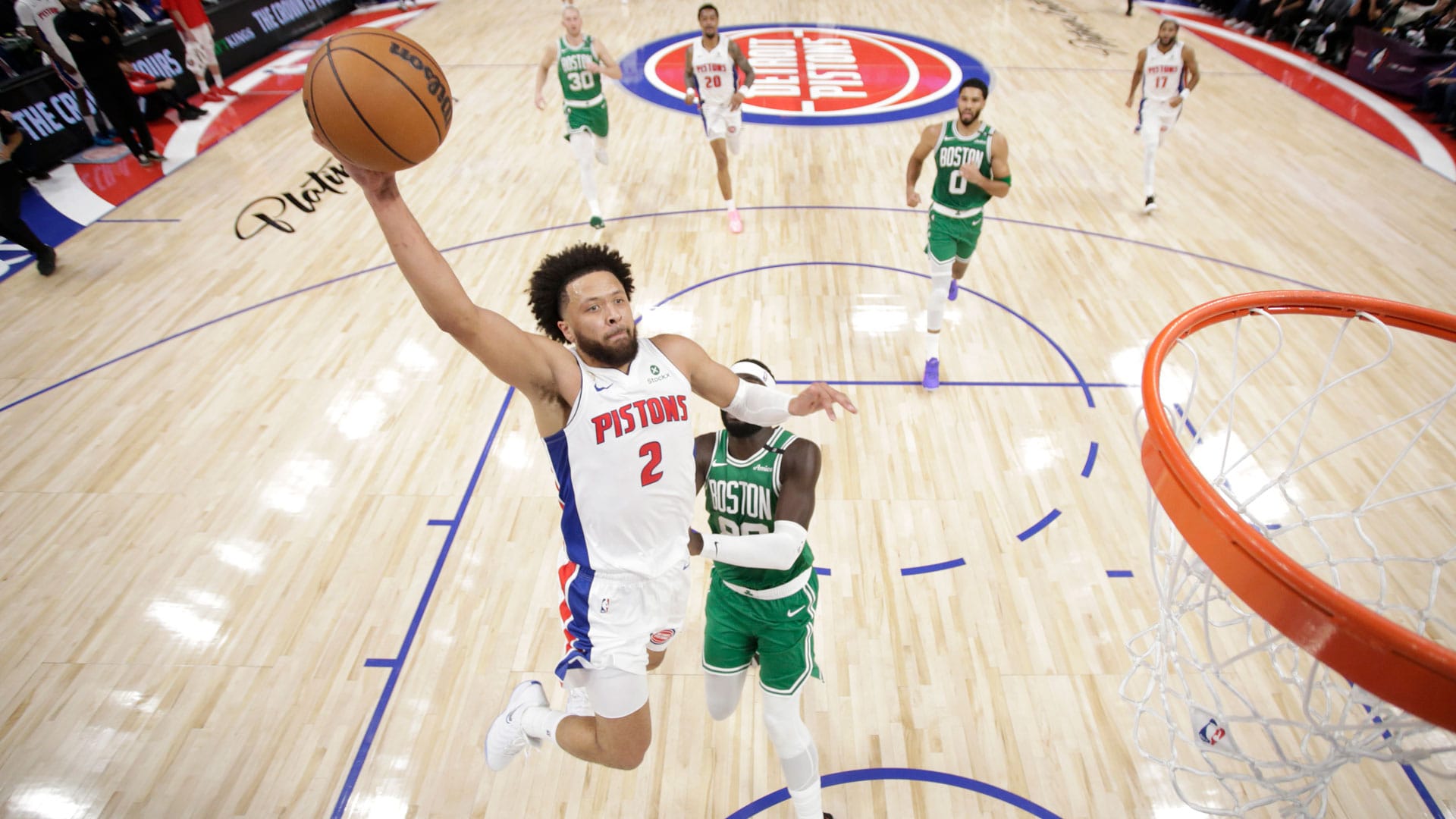
Jalen Brunson has been a fantasy basketball star since he arrived in New York.
You and a group of friends each draft a roster of real NBA players. Every night, those players produce real box score stats (points, rebounds, assists, steals, blocks, threes) and those stats become your team’s score. You compete against your league all season, adding and dropping players as things change.
If you’ve played fantasy football, the adjustment is volume and patience: 82 games instead of 17, lineups you may set daily, and cold streaks that are routine rather than a crisis.
If you want the simplest possible on-ramp, Yahoo’s High Score format strips fantasy basketball down to its essentials: a 10-man roster, five scoring categories, and only each starter’s best game of the week counting toward your total. This format can be considered the lowest-maintenance fantasy basketball with fewer lineup changes.
A few terms you’ll see constantly:
- Commissioner: Whoever runs your league and sets the rules
- Usage: How often a player’s possessions end with him shooting, drawing a foul, or turning it over. High usage means the offense runs through him
- Sleeper: A player you expect to outperform where he’s drafted
- Positions: PG (point guard), SG (shooting guard), SF (small forward), PF (power forward), C (center)
- UTIL / FLEX: A starting roster slot any position can fill
Step 1: Know your league format
Format changes player value more than anything else. Nearly every league is one of four types.
High Score (Yahoo): Yahoo’s newest fantasy basketball format, and the friendliest entry point on this list for a first-timer. You still play a weekly head-to-head matchup against a new opponent, but instead of counting everything your team does over seven days, only each starter’s single highest-scoring game of the week counts. One monster night is worth more than four quiet ones.
Scoring is stripped down to five categories:
- Points: 1 each
- Rebounds: 1 each
- Assists: 2 each
- Steals: 3 each
- Blocks: 3 each
Note what isn’t there: no turnovers and no shooting percentages. Nothing a player does can subtract from your score, which removes most of the ways a beginner accidentally loses a matchup.
Rosters are simplified, too. You draft 10 players and start six every week: two Guards (anyone with PG or SG eligibility), three Frontcourt players (SF, PF or C) and one Utility/Flex who can be anybody.
One rule is worth memorizing. You can still set your lineup daily, but benching a player erases the points he already banked that week and you cannot get them back. You can put him back in, but only the games he plays from that point forward count toward his High Score. When in doubt, leave your lineup alone.
Head-to-Head Categories: You face one league member each week and win by taking more statistical categories than they do, usually points, rebounds, assists, steals, blocks, threes, field-goal percentage, free-throw percentage and turnovers.
Head-to-Head Points: Same weekly matchups, but the winner is whoever scores more total fantasy points. Each stat carries a preset value:
- Points: +1
- Rebounds: +1.2
- Assists: +1.5
- Steals/Blocks: +3
- Turnovers: -1
Check your commissioner’s exact values before drafting. If turnovers are worth -1.5 instead of -1, ball-dominant guards lose real value.
Rotisserie (Roto): No weekly matchups. Stats accumulate all season, and you’re ranked in each category. In a 12-team league, whoever has most steals over the course of the season earns 12 points and whoever has the fewest steals earns one point — repeat the process for every category. The highest total across all categories wins.
The percentage trap
In category leagues, field-goal percentage and free-throw percentage are volume-weighted: a player shooting 50% on 20 attempts moves your team’s percentage far more than one shooting 50% on four attempts.
So a high-volume center hitting 65 percent from the field is a real weapon in FG%, but if he also shoots 50 percent from the free-throw line on eight attempts a night, he can sink your FT% by himself.
Step 2: Know your roster and lineup rules
Check four things before you draft.
Starters, bench and positions: Some leagues start one player at each of PG, SG, SF, PF and C; others use multiple UTIL/FLEX slots or only require G, F and C. Stricter requirements make positional flexibility more valuable.
Daily or weekly lineups: Daily leagues let you set a roster every night, which rewards active managers and makes mid-week injuries less damaging. Weekly leagues lock your lineup, so a Tuesday injury costs you the whole week.
High Score sits between the two: daily moves are allowed, but because benching a player forfeits the points he already earned that week, the correct option can often be to set it and forget it.
Injured Reserve spots: An IR slot lets you park an injured player and add a replacement without cutting anyone. Without an IR slot, injuries hurt much more, so favor durable players when drafting.
Playoffs: Most head-to-head leagues end with a playoff bracket for the top few teams, usually in March. Find out which weeks those are, since it shapes your late-season moves. Roto leagues have no playoffs; the final standings decide it.
Step 3: Draft day
Snake (serpentine) drafts are the default and the only format most beginners will meet. The order reverses each round, so the last pick in Round 1 gets the first pick in Round 2. Show up with a ranked list and let the board come to you.
A few leagues use salary cap (auction) drafts, where everyone bids on players with an identical budget. It’s rare for beginners.
Step 4: What makes a good pick
Three questions to ask about every player.
Role: Does his team trust him to create offense? Target clear top-three options on their team. Usage isn’t distributed evenly, so when one of those guys gets hurt, the others absorb the workload. Rule of thumb: 25-plus combined points and assists per game qualifies. This is also how you find sleepers late: look for someone who could be handed a bigger role than expected. Few centers clear the bar, which is why the ones who do are so valuable.
Injuries: Has he proven he can stay on the court? One workable definition of injury-prone is five or more seasons under 65 games, the NBA’s own availability threshold. That’s lenient toward young players and harsher on older ones, whose injuries compound.
Age: Is he at risk of decline? The number of 30-plus players who hold up for a full season drops sharply after 32 and falls off a cliff around 36. Treat 33 and up as a yellow flag.
One bonus factor: Players eligible at two positions give you flexibility, which helps you absorb injuries and keep every slot filled. F/C is most valuable because centers are scarcest, followed by G/F.
This changes a bit for High Score. Because only a player’s best game counts, ceiling beats consistency. A boom-or-bust scorer who explodes for 45 once a week is worth more here than a metronome who gives you the same 28 every night. Games played matter for the same reason: four games in a week means four chances at a big number, two games means two. And since turnovers and percentages don’t exist in this format, high-usage guards lose their usual drawback. Role still rules everything.
When to break these rules: These factors limit downside while you build your core. A standard draft runs 12 to 14 rounds; around round 6 to 8, start swinging for upside instead, targeting players who’d be impossible to replace if they hit. Age and injury both become acceptable there. Role doesn’t. In a 10-round High Score draft, that switch comes sooner, around round 4 or 5.
Step 5: Work the waiver wire
The waiver wire is where every player who isn’t on a roster lives: guys nobody drafted, plus anyone another manager has cut. It’s the single-biggest edge available to an active manager, because most leagues are won through mid-season adds and drops.
Two mechanics to know. When someone drops a player, he typically sits on waivers for a day or two before anyone can have him, and competing claims all process at the same set time rather than first-come. Once that window passes, he becomes a free agent, and in some leagues, it’s a straight race where whoever clicks first gets him.
Claims are settled in one of two ways. Record-based waivers give first priority to the worst teams in the league. Budget-based (FAAB) gives everyone a set budget for the whole season and awards the player to the highest blind bid. If you’re in a FAAB league, pace yourself. Blowing 40 percent of your budget on a week-two hot streak leaves you helpless in February when a starting center actually goes down.
What you’re hunting for is opportunity: a starter hitting the injury report, a coach shuffling the rotation, a trade clearing out minutes.
How aggressive should you be? Treat your last two or three roster spots as rentals and churn them freely. Leave the core of your team alone. And think in weeks, not games. A five-game cold stretch is completely normal in an 82-game season. Before you drop anyone, ask whether something actually changed, or whether you’re just reacting to noise.
Where to start
If this is your first season, a High Score league is the shortest path from curious to playing. Ten picks, six starters, five categories, nothing that can cost you points and leagues are now open.