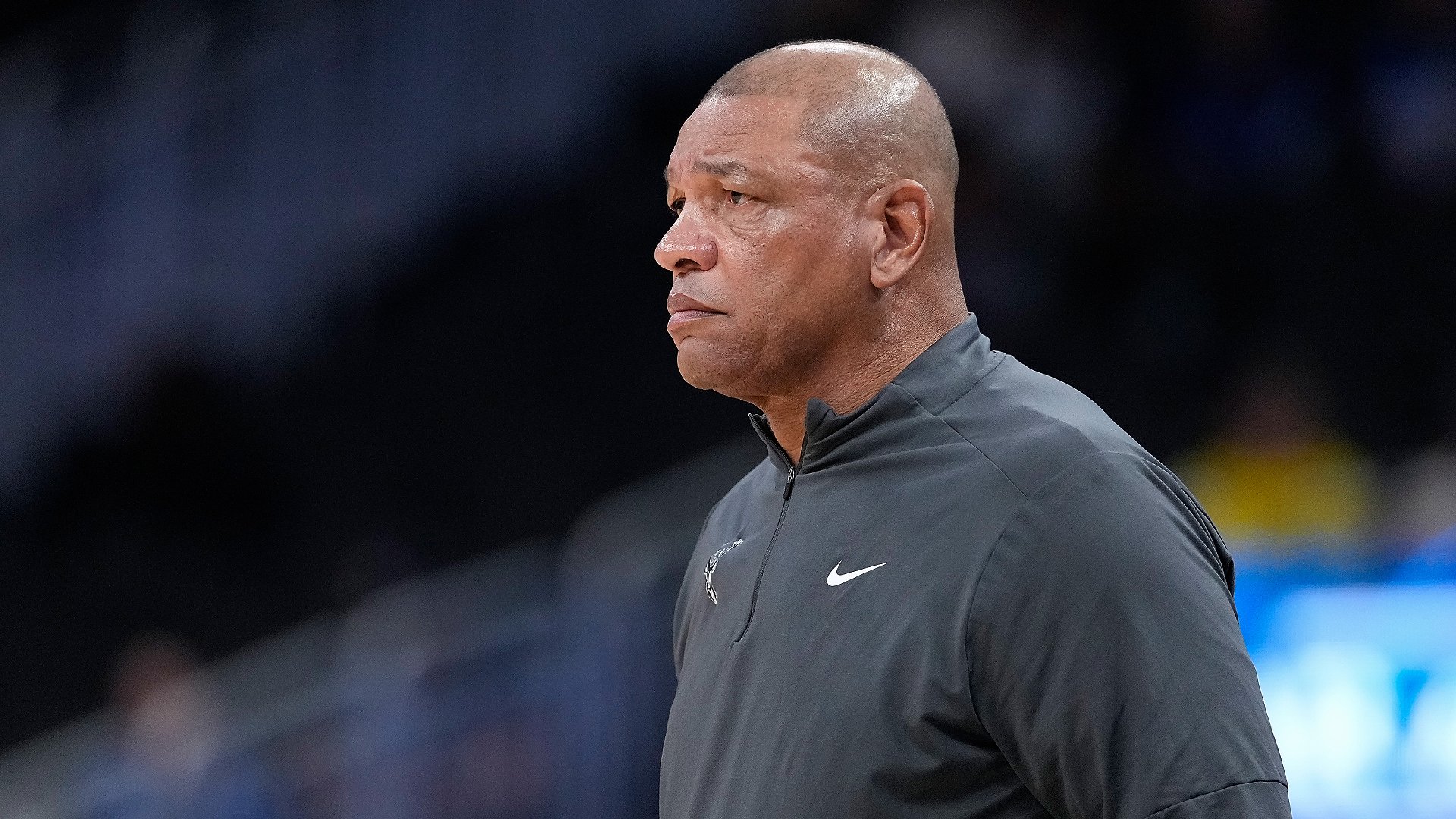

Doc Rivers says he made a Hall of Fame coaching career out of “just showing up.’
Doc Rivers’ enshrinement this weekend in the Naismith Memorial Basketball Hall of Fame can be explained succinctly by a quote made famous by filmmaker Woody Allen: “Eighty percent of success is showing up.”
Few in NBA history have shown up quite like Rivers, who has been involved as a player, broadcaster or coach for 43 of the league’s 79 seasons.
As a coach – the role for which he will join the rest of the Class of 2026 at the Hall’s ceremony Saturday in Springfield, Mass. – Rivers, 64, ranks sixth among the 11 men who have won at least 1,000 times. He is sixth in victories (1,194), seventh in losses (866), seventh in games-over-.500 (166) and fourth in playoff victories (114).
But if you add to Rivers’ 2,060 games as coach for five franchises (Magic, Celtics, Clippers, Sixers and Bucks) to his 864 appearances as a point guard for four teams over 13 seasons, his involvement on the court or sideline reaches rarefied air.
Only Hall of Famers Lenny Wilkens and Don Nelson have participated in more than Rivers’ 2,924 total games. Wilkens, with 2,487 games coached and 1,077 played, is No. 1 in NBA history at 3,564. Some of those count double, of course, given Wilkens’ four seasons as player-coach in Seattle and Portland.
Next is Nelson, who played 1,053 games in 14 seasons mostly with Boston before coaching another 2,398 for the Bucks, the Warriors, the Knicks and the Mavericks.
Then it’s Rivers’ 2,924 appearances, which has him in front of Jerry Sloan (2,779), Phil Jackson (2,447), Pat Riley (2,432), Larry Brown (2,378) and everyone else. Those totals dwarf any players who didn’t or have not coached, including LeBron James (1,622) and Kareem Abdul-Jabbar (1,560).
So while James achieved notoriety last season (his 23rd) by playing with or against approximately 34% of all men who have competed in the NBA, Rivers surely has him beat in raw numbers, with a 45% advantage over James in appearances.
Rivers got to the NBA in time to play against legendary opponents such as Nate Archibald, Elvin Hayes and Bob Lanier in their final seasons. He was on Milwaukee’s bench just a few months ago coaching against the likes of Cooper Flagg and Victor Wembanyama.
“It’s so funny, never in my life did I dream that I would be a coach or be good at it,” Rivers told NBA.com last week in an extended interview. “It was not on my radar.
“To be going in the Hall now, my mom had this saying, ‘For the good or bad of it, you’re right where you’re supposed to be.’ She used it all the time.”
No one was going to argue with Bettye Rivers, then or now, any more than they’d balk much at something her police officer husband Grady had to say.
Bettye was the one who introduced her son Glenn to basketball, taking him to games at Proviso East, her old high school in Maywood, Illinois, outside Chicago. That’s the same school where Rivers became a highly recruited prospect, around the time Glenn became “Doc” at a summer basketball camp in Milwaukee.
Al McGuire, the former Marquette coach turned broadcaster, was notorious for not remembering even his own players’ names. So the T-shirt Rivers had on – depicting the legendary Julius (Dr. J) Erving – became his forever nickname once McGuire’s assistant, Rick Majerus, introduced them. (The first time a nervous Rivers faced Erving’s Philadelphia team as an NBA rookie a few years later, the Sixers star smiled, extended his hand and called him “Doc.”)
Rivers spent three years at Marquette before being drafted No. 31 by Atlanta in the second round of the 1983 Draft. He joined a Hawks team on the rise, connecting early with scoring star Dominique Wilkins and soon forming the starting backcourt with Randy Wittman. Rivers earned an All-Star berth in 1988 and helped Atlanta make the playoffs six times in eight seasons. He moved to the Clippers, the Knicks and the Spurs, hanging onto playbooks from each stop that would lay the foundation for his future work.
“I don’t think either one of us thought too much about being coaches once we got done playing,” said Wittman, who coached for 24 seasons, including head coaching stints in Cleveland, Minnesota and Washington. “There are traits you have as a player that transfer over, obviously: communicating, being a leader on the floor.
“What Doc was great at was communicating, whether it was on TV explaining the game or talking with media or dealing with players. He could speak with them in a way that players understood and believed.”
Rivers spent his first three post-playing seasons as a broadcast analyst for the Spurs. Nice gig but miscast, according to a couple of his former coaches. Mike Fratello, his coach in Atlanta, saw the coach in Rivers and said so. So did Riley from when the two were in New York.
“Riley demanded that I be a coach,” Rivers said. “It was like a fistfight when I did TV those years. I’d do Miami games and he’d walk over to me at the table, ‘Get in the [expletive] fray! That’s who you are.’”
The call came in 1999 from Orlando, with 37-year-old Rivers hired to replace 68-year-old legend Chuck Daly. The Magic roster he inherited lacked star power and talent, but it overachieved to finish 41-41, earning Rivers the 2000 Coach of the Year award.
Doc Rivers NBA Coach of the Year Moment from 2000
“My first year [coaching] probably was my most important one,” Rivers said. “Before the season Sports Illustrated ranked the top 300 players ane we didn’t have one. It forced me to be creative, it forced me to really lead that group. That was our ‘heart and hustle’ team, one of my favorites I ever coached.”
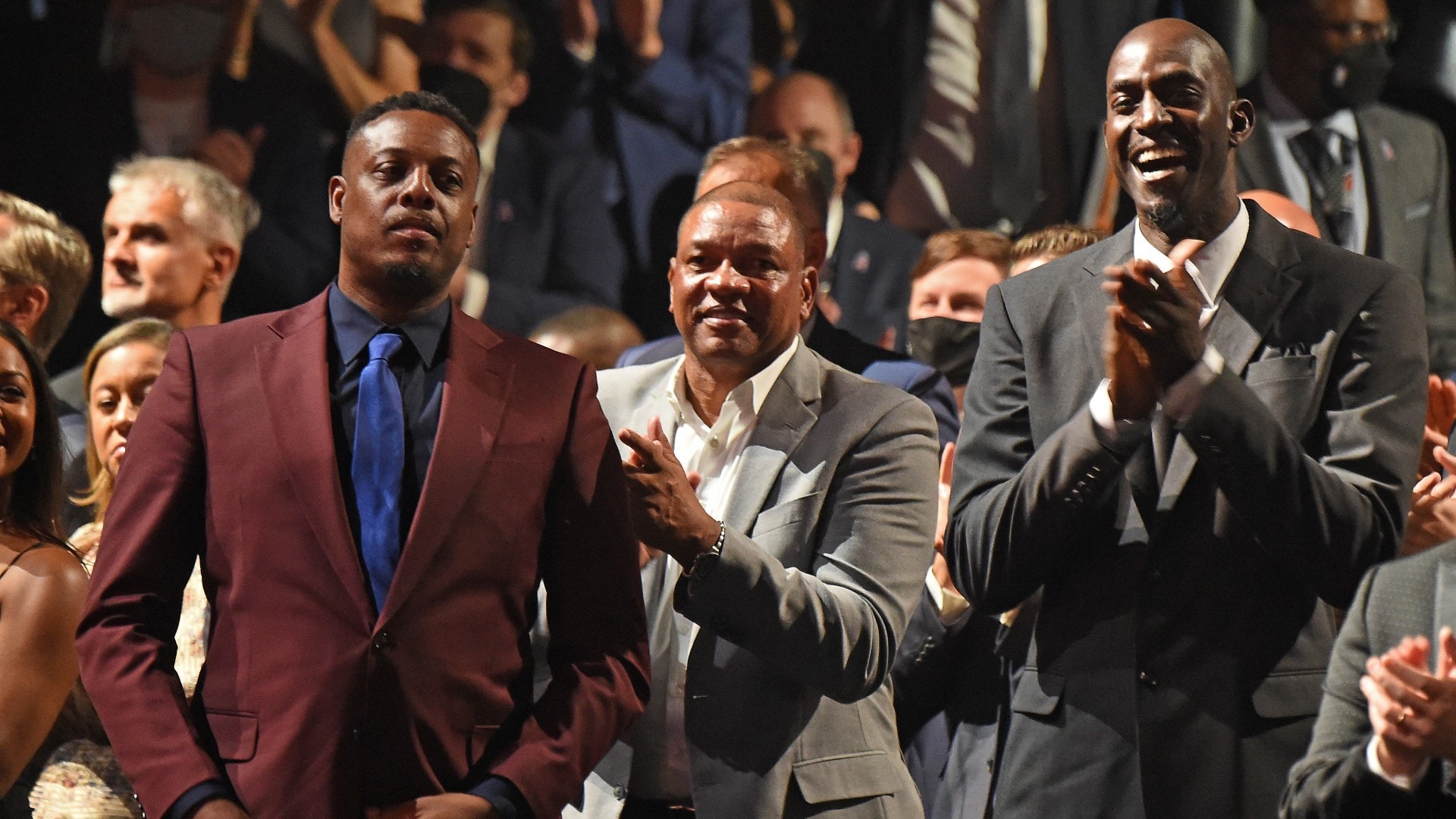
His favorite, no surprise, was the 2007-08 Celtics. Rivers had gotten to Boston three years earlier, the team beginning a three-year slide and in need of a makeover. It came in the summer of 2007 when Kevin Garnett and Ray Allen were acquired to play with Paul Pierce in what turned out to be an instant championship.
Quick didn’t mean simple. Getting three franchise players to blend their skills took persuasion and sacrifice. Rivers took them on a duck boat ride as a preview of what could be the Boston parade route if they won. Then he laid things out for the veteran stars.
“I told them, ‘You each averaged 20 shots a game last year. That’s not possible now.’ I remember Kevin saying, ‘You can have all 20.’ He was sincere, like ‘What is it going to take for us to win this year? You tell me that and I will do it.’ That set the tone.”
That group won 29 of its first 32 games, finished 66-16 and ranked first in defensive (98.1) and net ratings (10.8). Rivers introduced his “Ubuntu” culture to the NBA vernacular, an ethos in which the individual’s success hinged on the team’s. That and the early success kept everyone committed, and after two unexpectedly tough seven-game series vs. Atlanta and Cleveland, the Celtics beat Detroit and the Lakers in six games each.
As celebration chaos rocked TD Garden and the home locker room, Rivers retreated to his office and, oddly, stayed there. To this day, he can’t explain precisely why.
“My dad had died during the season, and I never got a chance to mourn. I really think that’s what it was,” Rivers said. “I remember smoking a cigar and reminiscing about the season and crying obviously about my dad. By the time I came out, the celebration was over. I must be the only coach in history who never made it to the locker room.”
Garnett’s strained right knee in 2009 made sure Boston didn’t repeat. Kendrick Perkins’ knee injury in Game 6 of the 2010 Finals cost the Celtics that one and the clincher. It wasn’t long before that core aged out and Ainge was contemplating a rebuild. Rivers wasn’t interested and thus, after the 2012-13 season, became the rare coach traded for a future first-round draft pick. (George State guard R.J. Hunter became the trivia answer as the player selected with that 2015 pick.)
Said Rivers: “To go back to what my mom said – ‘You’re right where you’re supposed to be’ – I wanted to win a championship as a player but never did. Instead, I won one as a coach. And in some ways that may be more gratifying. You had to do more than just play – you had to inspire a group of guys to function together and succeed.”
That was the plan in Los Angeles when Rivers joined a talented Clippers team with Blake Griffin, Chris Paul and DeAndre Jordan that had won 56 games the year before. The Clippers went to the playoff six times in the next seven years but never got passed the West semifinals. They went 356-208 in the regular season and 27-32 in the postseason.
Rivers’ two biggest achievements there was steering the players through former owner Donald Sterling’s sordid exit, and learning that he didn’t really want to handle the dual jobs of coach and chief basketball exec.
“I’ve always thought I would be very good in the front office,” he said last week. “But you can’t be both. There’s just not enough time in the day. It puts you in an awful spot.”
Coughing up a 3-1 lead to Denver in the 2020 Orlando Covid “bubble” had Rivers on the move again. Daryl Morey, who had wanted to hire him in Houston, got to Philadelphia and made the offer from there five days after the Clippers fired him.
Said Wittman: “Doc didn’t seem to worry about getting fired. He figured he’d go out and get another job.”
Philadephia was loaded with expectations and issues. Center Joel Embiid was healthy and dominant for much of Rivers’ three seasons there, but Ben Simmons was about to head sideways. Then James Harden and his spotty playoff play arrived.
The Sixers went 154-82 in Rivers’ three seasons and 20-15 in the playoffs, but lost Game 7 to Atlanta in 2021 and Boston in 2023. Rivers took the fall again.
“Trust is tough,” he said. “I’m always empathetic about it when I hear coaches say, ‘Aw, that guy is a bad guy.’ I defend the player by saying, ‘He’s just not buying your [stuff]. That doesn’t make him a bad guy.’ But the players you got it right with were worth all the others.”
Rivers went back into broadcasting at that point, joining ESPN’s revamped crew next to Mike Breen and Doris Burke for 2023-24. Halfway through, though, he was hired by Milwaukee to fix a situation that didn’t look broke: Rookie coach Adrian Griffin had the Bucks at 30-13, two year removed from their 2021 title and with Damian Lillard on board, when Rivers came in as his replacement.
Not having Giannis Antetokounmpo healthy for playoff runs doused the dreams in Milwaukee. After going 48-34 in 2024-25, the Bucks bailed on Lillard and sputtered to a 32-50 finish last season. Rivers resigned at the end. Antetokounmpo is gone now too.
“It’s humbling and satisfying,” Rivers said of coaching. “When I started to coach, I didn’t know if I would enjoy it, dislike it or what. Fortunately I loved it.”
At 64, he is in granddad mode, his four children – Jeremiah, Callie, Austin and Spencer – grown and successful. He golfs constantly – shortly before his interview for this story, Rivers had just come off the links at the Bel Air Club in California, from a foursome that included tennis great Pete Sampras. He would be open to TV again or a front-office opportunity, but his coaching days most likely are over.
The Hall of Fame honor and the looming enshrinement weekend have dialed up his appreciation and memories.
“It’s amazing how many players have called me,” Rivers said. “But this thing has made me reflect on how it’s not about me. It’s about the coaches and the players and my assistant Annemarie [Loflin]. You realize that no one does anything like this by themselves. All the coaches with me who were so smart – Ty Lue, [Tom Thibodeau], Lawrence Frank, you just go down the list. This is a celebration that I met a collection of people who helped me get to the Hall of Fame.”
Steve Aschburner has written about the NBA since 1980. You can e-mail him here, find his archive here and follow him on X.