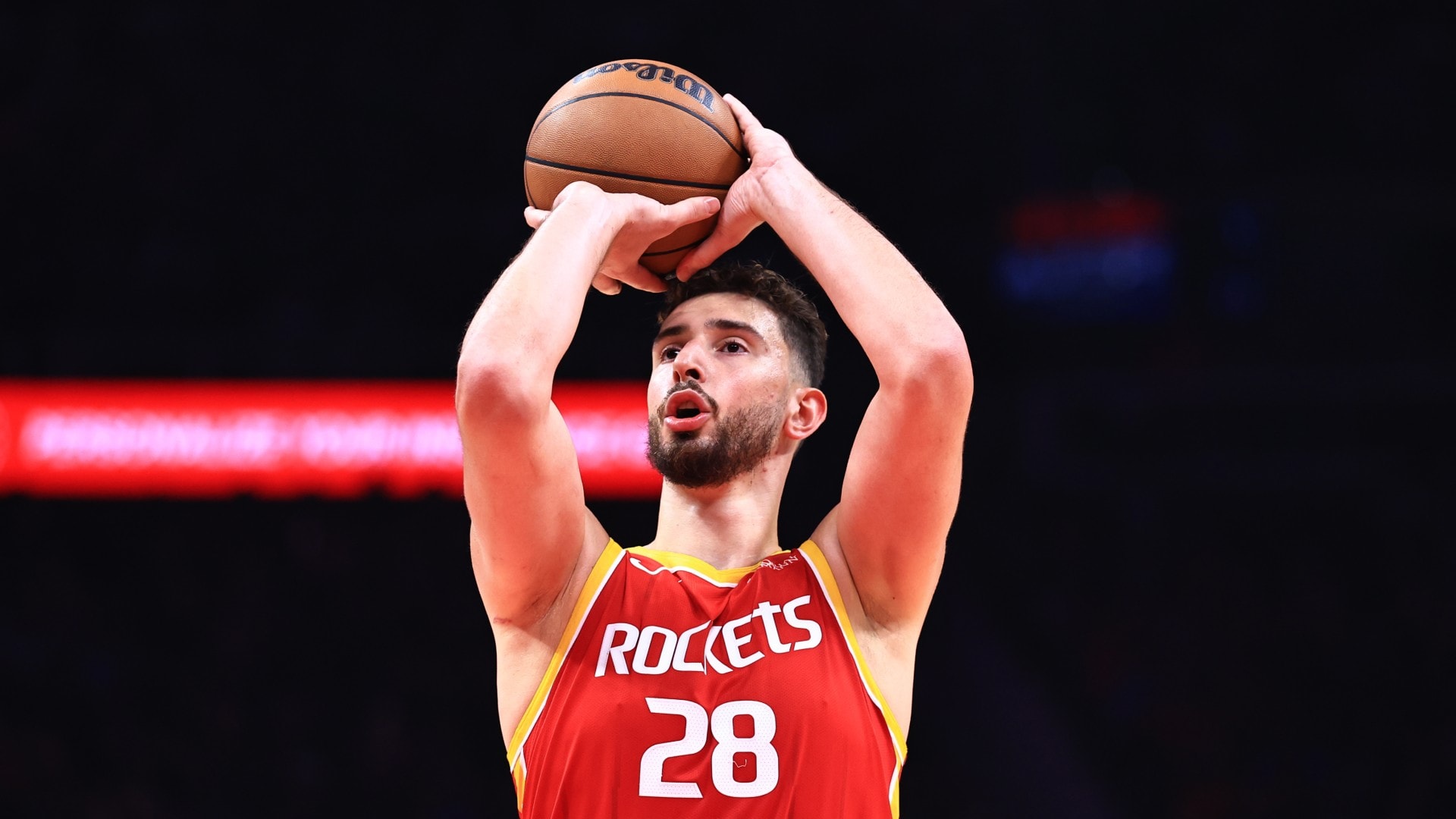
Alperen Sengun is taking his game to another level in Houston.
Editor’s Note: Read more NBA coverage from The Athletic here. The views on this page do not necessarily reflect the views of the NBA or its teams.
***
Last year, there wasn’t much of a debate about who the Houston Rockets’ most important player was. It was Kevin Durant. End of conversation.
This year, it is an open question, one that might have a new answer. You can credit Alperen Sengun for that.
Sengun hasn’t just been the driving force behind the Rockets’ impressive 12-4 start. He’s proving that his name belongs in much bigger conversations than who might make the All-Star team in February.
In his 14 appearances, the 24-year-old is averaging career-highs in points (21.6), assists (6.8), field-goal percentage (54.5) and 3-point percentage (50). Before being knocked out of the first half of Wednesday’s game with an eye injury, he was flirting with joining Nikola Jokić (six times) and Wilt Chamberlain (twice) as the only players to ever average more than 20 points, nine rebounds and seven assists for an entire season while shooting 55 percent or better. (He is questionable for Friday’s game in Denver because of a corneal abrasion.) He has plenty of time to bump those numbers up.
Sengun already has two All-Star nods under his belt, but it appears he is leveling up at the perfect time as Houston begins to establish itself as a serious threat to win the Western Conference. And if he is at least grabbing co-star status alongside Durant, that is a positive development for the Rockets, now and for the future.
One of the fatal flaws of last year’s Rockets was their overreliance on a superstar in his late 30s playing heavy minutes and taking the most important shots. That needed to change. Now, Sengun is doing his part to make sure Houston’s one-two punch is starting to feel more like a 1A and 1B.
A few things have notably changed as Sengun has made that leap.
The what and the where
While Şengün has already established himself as one of the NBA’s most effective offensive centers, his shooting efficiency has always dragged behind some of his contemporaries at the position.
Despite his devastating combination of strength and quickness in a 6-foot-11 frame, Sengun’s accuracy at the rim hasn’t been nearly as high as you might think. Sengun has often leaned too much on fadeaways and push shots in the mid-paint, perhaps because he has such a feather touch, rather than putting in the extra effort to get a closer, more efficient shot.
During his first All-Star season in 2024-25, Sengun shot 49.6 percent from the field, despite attempting only 90 3-pointers all season. It’s exceedingly rare for big guys to shoot below 50 percent from the field, let alone All-Star-caliber bigs.
This season, Sengun’s shooting percentage has jumped to 54.5 percent, and it’s largely because of where his shots are coming from. Per Cleaning the Glass, 51 percent of Sengun’s shot attempts have come at the rim this season. Not in the paint. At the rim. And he’s shooting a 68 percent on those shots at the rim, which ties his career-high he set last season.
Last season, only 42 percent of his attempts were at the rim.
Sengun has played with more physicality and has been more intentional about when and where he gets his shots. He’s getting better at knowing how defenses want to attack him and where he can find enough space to get to his moves. He’s also shown more patience when he has the ball in the paint instead of settling for tough floaters or one-foot fadeaways. Per Cleaning the Glass, 48 percent of his shots came in the midrange last season. That number has dropped to 37 percent this season.
Sengun’s talent has always been obvious, but it’s clear he’s putting more thought into his game and how he wants to attack opponents. His maturation has made Houston’s offense deadlier than ever. As long as he keeps getting shots at the rim at such a high rate, it will be difficult for most teams to slow him down.
The why and the how
Sengun is also becoming a bigger threat as a three-level scorer now that his 3-pointers are falling. In 14 appearances, he’s already made 14 of his 28 3-point attempts. Among players with at least 25 3-point attempts this season, the only ones shooting a higher percentage than Şengün are Mo Wagner, Cam Spencer, Corey Kispert and Derrick Jones Jr.
Sengun is still attempting only two or so 3-pointers per game, but the fact that they’re falling at a higher rate has already forced some of his primary defenders to think twice about leaving him open at the top of the key. Considering how shifty and strong Sengun can be off the dribble, any bit of indecision he can draw from defenders is all he needs to get an angle and get to the rim.
While Sengun has helped himself by knocking down more 3-pointers this season, the Rockets have become a much more dangerous perimeter team as a whole. It’s changed the dynamic for everyone within the offense.
The Rockets still don’t take as many 3s as several other NBA teams. But they’re making more of them at the most important times.
Sengun and Durant have repeatedly said how different things are for them this season now that Houston has more jump-shooting threats around them. It’s not as easy for opponents to send double-teams and ignore shooters on the opposite side as it was last season.
Through 15 games, the Rockets already have eight players with 10-plus 3s this season, including Sengun. That doesn’t include Amen Thompson, who draws a tremendous amount of attention from opposing defenses because he’s such a scoring threat in the dunker spot when Sengun has the ball.
Along with some of the usual suspects such as Durant, Jabari Smith Jr. and Reed Sheppard, the Rockets added Fred VanVleet back to the fold and signed two fearless shooters: Marcus Smart and Bogdan Bogdanović. Last season, teams dared Josh Okogie, Aaron Holiday or Dorian Finney-Smith to take open shots. It’s much more dangerous to give those easy shots up to VanVleet, Smart or Bogdanović on the weak side.
With all that extra room to operate, Sengun has been free to attack opposing bigs one-on-one in space, and he’ll usually win those matchups.
Sengun’s isolations are up, and his post-ups are down, partially because he has so much more room to operate at the top of the key. Last year, teams would’ve been much more willing to crowd him from the wings as he attacks from the top. Now, the Rockets have shooters that defenses have to respect.
Those extra shooters on the perimeter have also helped Sengun make more plays in pick-and-roll as the roll man. The same principle applies, with Sengun afforded more space when he catches the ball on the move. As dangerous as he can be around the basket, he might be even more dangerous finding shooters on the perimeter or tossing up lobs for Thompson.
The Rockets are probably at their best when the ball is moving and Sengun is creating shots for everyone at all three levels. When the 3s are dropping, this team is nearly impossible to defend.
The who
There was immense hype around VanVleet’s return following the torn right ACL that cost him the entire 2025-26 season. The veteran has somehow lived up to every bit of it.
And, as VanVleet told me before the season, his presence isn’t so pivotal because of the 3-pointers he can knock down or the high-IQ plays he can make to settle the offense. Rather, his presence on the court seems to put everyone else in the role they should be in. No one has benefited from this more than Sengun.
Last season, Sengun had to run the offense like a point guard and battle in the paint like a center. It was a lot to put on his shoulders, and there were times when he struggled to carry that weight.
Per Cleaning the Glass, only 45 percent of Sengun’s field goals last season were assisted. That’s astonishingly low for a center. For comparison, 61 percent of Jokić’s baskets were assisted last season.
Sengun spent so much time fighting off double-teams and creating his own shots. That’s part of why Houston was so predictable in the half court.
Sengun is playing with more freedom now that his veteran point guard is back running the show. Not to mention, VanVleet and Sengun have continued to build a special connection that helps them work off each other so well.
Per Databallr, a website that focuses on analytics in basketball, Sengun is shooting 60 percent from the field when he shares the floor with VanVleet (255 minutes) this season. That number dips to 46.4 percent when the Rockets big man plays without VanVleet (204 minutes). VanVleet also has 18 assists on Sengun’s baskets this season, which leads the team. Sengun’s 13 assists on VanVleet baskets more than double what he’s received from anyone else on the team.
The pick-and-roll with VanVleet and Sengun, with either of them handling the ball, has become a go-to play for Houston to routinely create good shots. VanVleet is also the best on the team at getting Sengun the ball in his favorite spots. The big man who spends so much time building up his teammates finally has his partner back on the floor, who builds him up better than anyone else.
It felt like everything was immensely difficult for Sengun. Now, the Rockets have the ingredients in place to make life much easier for him.
***
William Guillory is a staff writer for The Athletic, covering the Houston Rockets and the New Orleans Pelicans. Before joining The Athletic, he was a writer at The Times-Picayune/NOLA Media Group, and he’s been on the Pelicans beat since 2016. He is a New Orleans native. Follow William on X @WillGuillory.