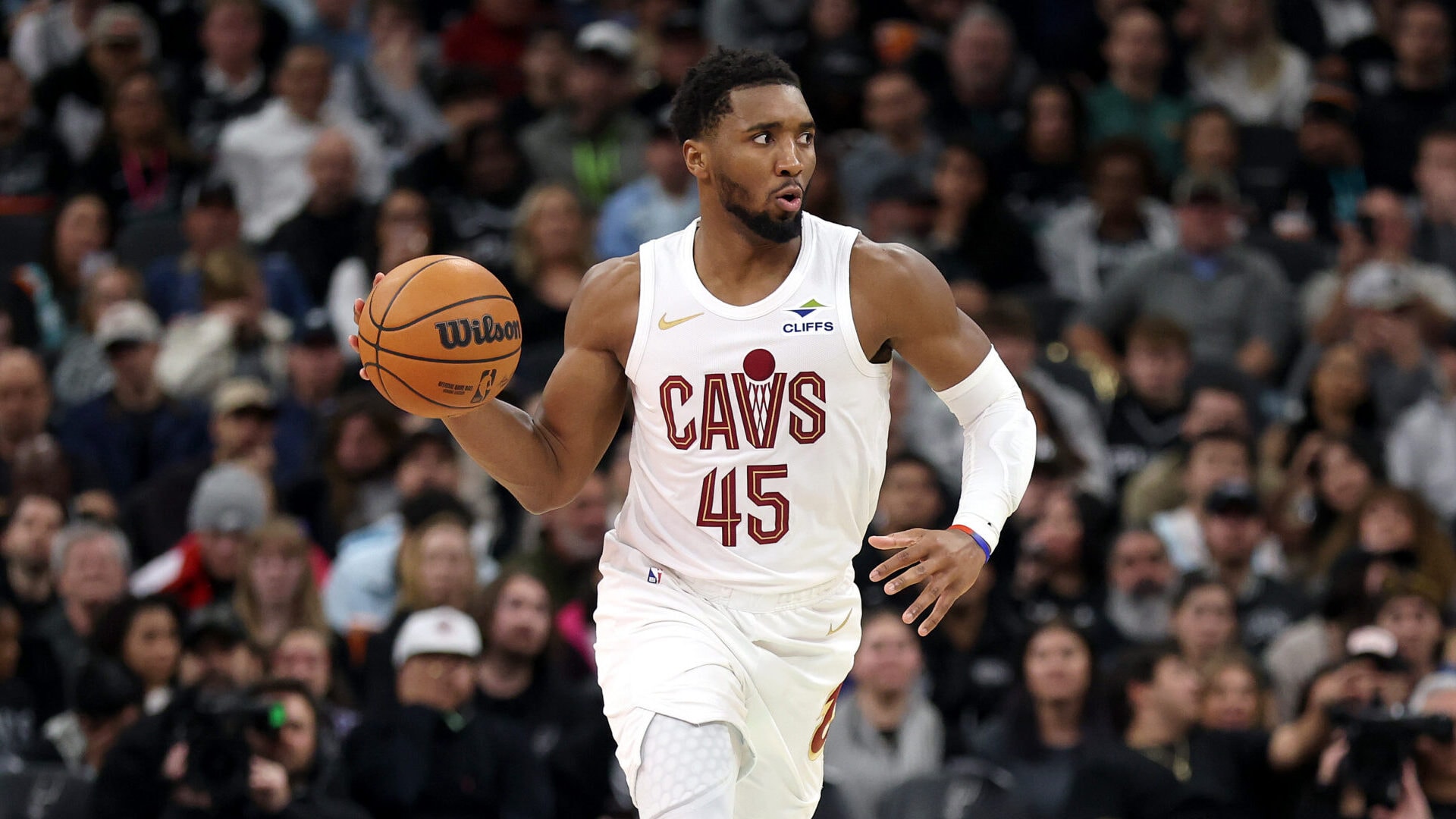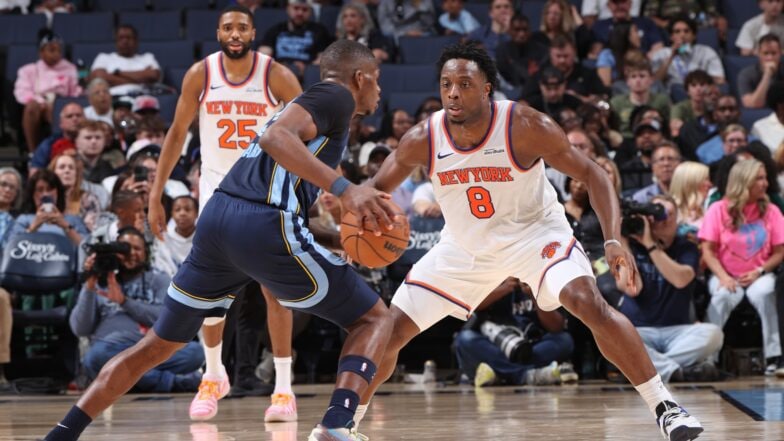
OG Anunoby leads this season’s All-Perimeter-Defense First Team.
OG Anunoby could tell the future.
No, the New York Knicks’ all-defensive wing didn’t know a pass would drift into his hands. He didn’t predict the exact fashion of yet another steal or the fast break that followed. But he could detect where the Denver Nuggets were heading next.
Clairvoyance came during an early-March decimation of the Nuggets. As Nikola Jokić walked up the court, directing his teammates, Anunoby picked him up. The three-time MVP stood upright, pointing at cutters. But Anunoby was already in his chest — because he understood what was about to happen.
The Nuggets run this play often.
“He wants to catch (at the top of the key),” Anunoby explained in a recent conversation with The Athletic. “And then, it’s a back screen action or (dribble handoff).”
The trick, as Anunoby puts it, is to “get him early.” Jokić has four inches and more than 40 pounds on him. But Anunoby is used to defending all types of players, one of the many reasons he headlines my All-Perimeter-Defense First Team. The Second Team was published last week.
In this game, alone, he guarded Jokić, high-flying forward Aaron Gordon, spot-up threat Cameron Johnson and 6-foot-4 everything-player Bruce Brown. When the Knicks played the Nuggets at Madison Square Garden earlier in the season, he was the primary defender on All-NBA probable Jamal Murray, a quick-twitch point guard with sweet shooting touch.
People talk often about players who can guard all five positions, but usually those comments are in reference to guys who switch onto any type of player — not who will begin possessions on an All-NBA behemoth like Jokić and also an All-Star guard like Murray.
Such is why the Knicks chose to build their defense, which has risen into the NBA’s top 10 and has ranked second in points allowed per possession over the past two-and-a-half months, around their perimeter stopper.
Beyond the tools, Anunoby is studious enough to anticipate without getting too risky. On this play, because he was in Jokić’s chest, the pass couldn’t come to the top of the key. He knows a screen from Christian Braun will follow.
“I see it’s coming, and I know I’m not gonna switch it,” he said. “I’m just gonna get around that.”
So, he jukes around Braun, a necessary move with the tinier Jalen Brunson in the action, then gets even more physical with Jokić.
This is one of Anunoby’s staples, the way he “fronts” larger post players, cutting off passing lanes but also disallowing an over-the-top lob. When guys are far from the hoop, such as Jokić is here, he’ll shove them toward the sideline. He successfully pulls off the same strategy when he mans former MVP Joel Embiid.
“It’s really just getting low, pushing him out with my legs,” Anunoby said. “Being strong, pushing him out but keeping on his body so he doesn’t spin out or anything.”
The supposed mismatch is too enticing for the Nuggets. Brown tries to wedge a pass into Jokić, who never touches the basketball. And Anunoby recovers one of his many steals.
With the NBA’s actual All-Defensive teams no longer including positions and thus filling up with a disproportionate number of centers, it’s time to give the wings and guards their proper appreciation.
Anunoby leads this season’s All-Perimeter-Defense First Team. Here are the other four players:
Derrick White, Guard, Boston Celtics
White has one mission whenever he meets a potential scorer at the basket.
“I just try not to foul,” he said in an interview with The Athletic.
At only 6-foot-4, White is the NBA’s shortest rim-protector, someone who the Celtics have used in a new way this season — and with roaring success.
Never before has White defended dribblers so little. Instead, Boston stations him away from the basketball, the keeper of the weak side, free to flick away passes, kill screening actions with switches and, somehow, block shots. Now, it’s as if he’s the guard version of prime Giannis Antetokounmpo.
White is averaging 1.3 blocks a game. When the season closes this weekend, he will become the only the second player of his height in history, joining Dwyane Wade, to do so. But he doesn’t just get a hand on the ball.
He swats shots in transition, speeding from the rearview to slap away finger rolls. He slides over as a helper, sprawling upward with two hands straight in the air, as if he believes himself to be Rudy Gobert. Opposing players are shooting just 55 percent on dunks and layups when White is the nearest defender, 13th in the NBA and first among guards by a landslide, according to Second Spectrum.
“Sometimes, you kinda panic, and you either foul or get out of the way,” White said. “You don’t (want that). My timing is pretty good. Just a little bit of both of that combines to hopefully them missing more than they make.”
Of the 26 qualifying players with a block rate as high as White’s this season, no one spent less time in foul trouble, according to Bball-Index. But sometimes, White will take a risk. Often, it will pay off, such as on this stampede he halted a month ago.
The thwarting of the Charlotte Hornets, one of the NBA’s fastest squads, is the quintessential White play. Naturally, White is the first player back on defense. He stays equidistant from Hornets forward Miles Bridges and center Moussa Diabate. After the pass comes to Bridges, who detonates passersby at the basket regularly, White goes straight up, though with a little more oomph than usual.
“Just be in the right position,” White said. “Sometimes, you get lucky.”
Of course, this was more than good fortune.
Bridges contorts his body, and jacks up an errant layup, but the play isn’t done there.
Look how quickly White goes from defending the rim to searching for the next open Hornets player. The closeout on LaMelo Ball, as confident a shooter as exists, is classic White, too.
Underrated is White’s ability to slow down quickly, a skill that makes him an elite shot-contester. In a moment, he’s sprinting at Ball. In another, he’s stutter-stepping without actually running into the shooter. He stops just short of Ball, who thinks twice about the jumper before launching a difficult 3-pointer, which falls short.
White doesn’t technically block a shot. He doesn’t force a steal. But in just five seconds, he takes away what should have been an easy layup and then what should have been a smooth triple.
The Celtics defense is 10.3 points per 100 possessions better when he’s on the court, according to Cleaning the Glass.
Scottie Barnes, Forward, Toronto Raptors
Most defenders, even great ones, need to approach the basketball to make an impact.
Not Barnes.
The fifth-year forward was a questionable member of the All-Perimeter-Defense team only because of his versatility. When the Raptors lost starting center Jakob Poeltl for a long stretch this season, they went small. In those times, Barnes would often line up against big men. Did he really qualify as a perimeter player this season?
The answer: Yes, he did. It’s not Barnes’ fault that, like Anunoby, he can guard everyone. After all, the Raptors constructed their defense around that concept.
Toronto’s goal is to string along offenses late into possessions, when the Raptors don’t have time to run second actions or create open shots. Their opponents average 15.1 seconds per possession, the slowest pace in the league this season, per Second Spectrum. They get there by switching nonstop.
No one does it better than Barnes — and not just because of his diverse physical tools. His communication is on another level, too.
Take this seemingly mundane possession from a mid-March game against the Phoenix Suns. It might appear as if nothing happens, a quick pick-and-roll from Jalen Green, which leads to a turnover. But look closer, and you’ll find Barnes’ savviness.
He begins the possession on Suns guard Jordan Goodwin. Immanuel Quickley is on Collin Gillespie. RJ Barrett takes Green, who starts a pick-and-roll that Barnes recognizes immediately as unconventional.
The Suns are about to stagger two screens, one from Gillespie and a second from Goodwin. Barnes knows it’s best to keep smalls defending their peers. So, he calls for what some teams call a “triple switch,” switching with the other screener’s defender before Goodwin gets to Green, keeping Barnes out of the action altogether.
The Raptors, Barnes especially, have excelled on these types of switches all year.
Barnes’ highlights around the basketball are obvious. He’s pulled off more game-winning stops than anyone else in the league in 2025-26. Clutch Player of the Year tends to go to whichever guy leads the NBA in points per minute at the ends of tight games. Maybe the sheer number of victory-clinching blocks Barnes has committed this season should place him in the conversation, too.
He’s averaging 1.5 swats and 1.5 steals on the year, which no one has done in tandem since Anthony Davis in 2019-20. He’s an elite retriever of the basketball. But on the above play, the Suns cough it up, even though Barnes isn’t anywhere near.
With 20 seconds on the shot clock, you can see him directing his teammates. Like Anunoby in the Jokić play, he too knows what’s coming.
Quickley and Barrett then switch defenders when Goodwin screens for Green. Barnes drifts to the corner with his new man, Gillespie. Green makes no progress.
It’s seven wasted for the Suns — until Quickley pokes the ball loose and causes a turnover, which happens across the court from the man who helped create it.
Ausar Thompson, Wing, Detroit Pistons
More than one call irked Thompson.
Not even three minutes into his first-ever playoff game in 2025, the feisty up-and-comer picked up his first postseason foul. This one came on an innocent prod at the basketball, a tap that occurred a solid 85 feet away from the hoop on which his assignment, Jalen Brunson, hoped to score.
Thompson tried to pressure Brunson for the rest of the series, which ended in the Pistons’ defeat. Sometimes, he made him uncomfortable. Other times, he reached.
“I didn’t think they were fouls,” Thompson said.
But that didn’t change his summer routine.
He worked on his ball-pressure after the Pistons fell in that first-round series, hoping he could learn to keep his hand out of the cookie jar. Thompson’s fouls were a problem last season. That needed to change.
Now, it has.
“I haven’t got as many fouls (this season),” Thompson said before smirking and keeping himself in check. “So, I guess I was fouling.”
The foul rate has tempered to a career low without any of Thompson’s patented aggression falling by the wayside.
He still presses anyone who can dribble. He leads the NBA in steals and deflections per game. He is second in the league in Bball-Index’s ball-screen navigation analytic and fourth in its off-ball chasing one. Only one other player even sniffs the top 10 in both stats: his twin brother, Amen, a member of the All-Perimeter-Defense Second Team.
Detroit’s defense, which ranks second in points allowed per possession, builds from the inside out. Its big men bully guys down low. But its perimeter defenders shove opponents around, too. And that starts with Thompson, who is only getting better.
Cason Wallace, Guard, Oklahoma City Thunder
There is no evidence of Wallace saying please. Only of his theft.
He fits right in with the Thunder.
Wallace is Oklahoma City’s version of White, a gutsy guard capable of guarding the ball, yet who makes most of his impact away from it. The Thunder will suffocate anyone they face. Lu Dort mans the other team’s best player most often. Alex Caruso, who may be the best defensive guard in the sport but doesn’t play enough to qualify for the 65-game rule (and thus, is not on either All-Perimeter-Defense team), wreaks havoc. The rest of the crew follows suit.
So, Wallace disrupts passing lanes in a way that most people his size cannot.
He’s in a virtual tie with Thompson, a 6-foot-7 wing, for the league lead in deflections per game, even though he’s four inches shorter. He’s right there with Thompson in steals, too.
If Wallace were on any other team, he would be its on-ball hound. And he would make even more plays like the one below, where he picks Anthony Edwards’ pocket.
Of course, Wallace already rips the ball away from dribblers more than anyone else.
Seventy-six of his steals this season have come while defending the basketball, the most in the NBA, according to Second Spectrum. Many of those are in the backcourt, results of his 94-foot pressure.
His most recent victim was the Utah Jazz’s Kennedy Chandler, who received a hasty inbounds pass with 2.3 seconds to go in a quarter, only for Wallace to meet him in a defensive stance, swipe the rock away and splash in a buzzer-beating floater. He’s robbed dribblers in the backcourt eight times just since the start of February. And he’s never said thank you, either.
***
Fred Katz is a senior NBA writer for The Athletic. Follow Fred on Twitter @FredKatz